


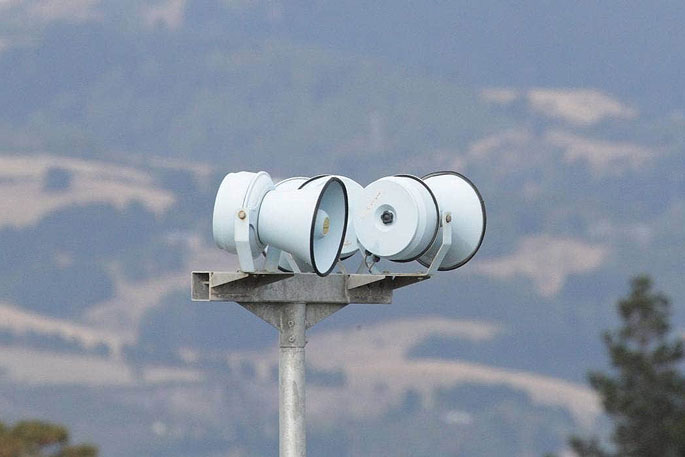
Tsunami sirens for Mount Maunganui and Pāpāmoa have been talked about for nearly 20 years, but despite having funding council want to remove them from their work programme.
In 2019 Tauranga City Council approved a budget for the sirens, something then councillor Steve Morris was 'really pleased” about.
Morris has advocated for sirens for at least 12 years and thinks they should be a priority as a secondary warning system.
Council has just finished consulting on the use of tsunami sirens as part of 2021-31 long-term plan.
The cost of the sirens is $3.9 million with an ongoing cost off $209,000 per annum, according to council.
Morris says this is small price for 'critical, potentially lifesaving infrastructure”, especially in comparison to the $300 million council is proposing for the build of a new civic precinct in the Tauranga CBD.
'I think it's a matter of priorities,” he says.
'The first thing is to actually understand what a siren is for and that is as a backup to the primary mechanism, which is the natural warning signs, and not to get bogged down in the bureaucratic arguments about it.”
Council manager of emergency management Paula Naude says there are pros and cons to tsunami sirens.
'International evidence shows us that the risks associated with community reliance on a siren to know when to evacuate can be more dangerous than no siren,” she says.
'The best and most reliable warning system for local source tsunami in New Zealand is the natural warning.”
The natural warning is if an earthquake is long or strong people should evacuate and not wait for an alert.
'There have been advances in knowledge, data and technology since sirens were first discussed for Tauranga,” says Paula Naude.
'Based on the best available information, it is no longer considered that sirens are the safest solution for our community.”
Emergency Management Bay of Plenty director Clinton Naude says the BOP Civil Defence Emergency Management Group does not regard sirens as an effective or a reliable alerting mechanism in local source tsunami events.
He says there are currently no sirens in the region.
The Bay of Plenty CDEM group includes the seven councils from the region. These are Bay of Plenty Regional Council, Tauranga City, Western Bay of Plenty, Whakatāne, Kawerau, Ōpōtiki and Rotorua Lakes Councils.
Clinton Naude says some disadvantages of tsunami sirens were local source tsunamis could arrive within minutes, so there may not be time for an official warning.
'Sirens may also be damaged by the earthquake itself and therefore cannot be activated,” he says.
'Sirens are known to cause complacency, which undermines the most reliable warning system for local source tsunami - the natural warning itself.”
If evacuation is required alerting systems include the emergency mobile alert (EMA), radio, television, social media and loud hailers, says Clinton Naude.
 Former councillor Steve Morris is a strong advocate for tsunami sirens. Photo: Supplied.
Despite the other systems available, Morris says there is still community support for sirens.
'What we found with Mount and Pāpāmoa residents in particular, is that they wanted, an addition to the text message system and knowing the early warning signs,” he says.
'They wanted to be alerted via public siren system as well.”
In 2012 the Pāpāmoa Residents and Ratepayers Association (PRRA) set up temporary air raid sirens and conducted their own tests.
Morris was chairman at the time, he says the sirens were widely heard in Mount Maunganui and Pāpāmoa.
He says this 'really annoyed” the council of the day but it showed sirens could be widely heard.
Current PRRA chairman Philip Brown says the association thinks sirens are essential.
'We've always asked for them,” he says.
'We always thought they are part of the mix of getting the warnings across and the evacuation message across, we've never deviated on that.
'The fact that there are other high tech solutions coming along, we think sirens are a great complementary fit.”
When asked what he thought of removing sirens from council's work programme, Brown replied: 'Do they want to kill people?”.
 Pāpāmoa Residents and Ratepayers Association chairman Philip Brown. Photo: John Borren/SunLive.
He says there are limitations to the EMA.
'Not everyone has a cell phone, not everyone hears their cell phone,” says Brown.
'Not everyone wakes up for their cell phone, but with a continuously sounding tsunami siren they will wake up.”
He says there's no quick inland escape route for people in Mount Maunganui and Pāpāmoa so people need as much warning as possible.
Plans to install sirens along the Western Bay of Plenty coastline were launched in in 2005 after the 2004 Boxing Day tsunami in Indonesia.
Back in 2006, 10 sirens were tested between Waihi Beach and Pukehina, however 'black spots” were discovered where the sirens couldn't be heard.
Both Tauranga City Council and CDEM Bay of Plenty were unable to tell Local Democracy Reporting if this resulted in sirens being installed due to a lack of 'sufficient information”.
Morris wants to see action on siren installation rather than more consultation.
'The dithering and dragging out has gone on way too long in my view.”
Public Interest Journalism funded through NZ On Air.


5 comments
A reminder
Posted on 28-04-2022 19:53 | By Informed
If we need a reminder why previous councils caused such massive issues in Tauranga. This is another example of ex councillors still not listening to what local experts or even global science tells the, instead they keep acting like they are the experts and smartest people in the room. They continue to remind us that they should never be allowed to be in charge of Tauranga again.
@ Informed
Posted on 29-04-2022 07:34 | By Yadick
HEAR, HEAR. Absolutely agree with your comment. What an utter disgrace for this having dragged on for nigh on 20yrs. How much has this cost in consultants, how much has the budget skyrocketed. We need [new] proactive talent on our Council. It's time for the old stick in the muds to be right off the scene.
It's the Muppet Show
Posted on 29-04-2022 13:20 | By msmafia
230,000 people died in Indonesia from a tsunami they had no idea was coming. An off shore earthquake no one felt triggered the devastating wave. A siren causes complancency is the most idiotic statement ever.
sirens
Posted on 29-04-2022 18:51 | By dumbkof2
for goodness sake get the air raid type sirens installed. these are a fraction of the cost of anything else
2005/2006
Posted on 30-04-2022 00:23 | By Centurion
As one of the architects of the test in 2006 said at the time 'One of the elements of the test is to identify those areas where existing sirens can not be heard, and where additional units will need to be installed. Following the test, Councillors squashed the scheme on the grounds that the ten existing sirens were not heard in all coastal locations! Would you believe that they even listened to a complaint from a resident in Soldiers Road (Kaimai) that he could not hear them, despite being miles from the coast. Cost at the time was estimated to be less than $80,000 to establish the entire system.
Leave a Comment
You must be logged in to make a comment.