


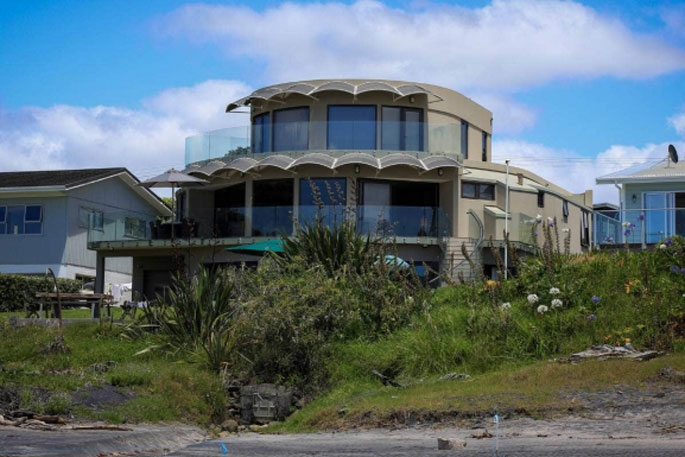
The Thames-Coromandel District Council has been ordered to pay half of the $811,138 cost for a botched repair job of a leaky home in a paradisiacal holiday spot.
In a recently-released High Court judgement, Justice Anne Hinton ruled $405,569 in damages be paid by the council to a family trust that had brought proceedings against it.
The judgement brought an end to a lengthy saga of finger pointing, repairs to repairs, and a lot of water ending up where it shouldn't be.
The house on Wharekaho Beach, also known as Simpson's Beach, was built in 1997. It has many features typical of the houses built in that era that became known as 'leaky homes”, including a wedding cake design, flat roofs, curved walls, and monolithic cladding.
The distinctive property was purchased in 2003 by a trust created by Dr Brian Joseph Linehan – a former managing director at Medlab Hamilton, a leading Waikato Hospital pathologist and pro-chancellor at Waikato University.
It changed hands a decade later to a different trust – the Eliza Trust – also created by Linehan.
While Linehan was aware in 2003 that the house had been deemed leaky, the problems did not become apparent until 2010, when water started collecting in the ceiling of the garage and bunk room.
He hired a builder, Bernard Barber, who professed to be an expert in repairing leaky homes. Barber carried out major repairs on the house in 2011 and on the upstairs balconies in 2016.
Although the trustees initially claimed negligence against Barber and others who were involved in the works in some way, the legal action against all defendants other than the council were later discontinued.
Barber's work included re-cladding the house, installing new double-glazed aluminium windows, extending an existing deck, and removing 'high-risk” features of the dwelling related to its curved walls. Deck tiles were also replaced, and alterations were made to staircases and an entrance foyer.
But much of that work proved to be either inadequate or defective. Barber did not initially apply for building consent, and an architectural planner he engaged was not asked to identify the source of the leaks.
The trustees pointed the finger of blame at the council, which they said was negligent in issuing building consents, inspecting, and issuing code compliance certificates for both the 2011 and 2016 works.
A High Court judgement has decreed there was blame on both sides for the botched repair job.
They claimed the cost of repairs, stigma, and associated damages totalled $1.55 million, and also sought a further $197,528 for the wasted cost of the balcony repairs, which had been deemed a total failure.
While the council conceded it had been remiss in certifying the 2011 repairs and issuing building consents for the 2016 repairs, it disputed the amount the organisation was liable for, and estimated the cost of the works to be no more than $581,310 – which it should only have to pay half of.
As the lengthy High Court judgement reveals, Barber had begun work in mid-2010 without first getting council building consent or a report from the architectural planner. For some reason a nearby resident complained, council inspectors paid a visit, and a 'stop-work” notice was issued.
Barber had to wait until September of that year for the building consent to be granted. He then resumed the work, which was completed in December 2011.
The council carried out inspections and eventually, on 19 December 2011, issued a code of compliance certificate.
But that sign-off was premature. By Christmas 2014 tiles on the balcony deck had begun to lift and water had begun 'pouring” into the lounge below.
Linehan again hired Barber to fix the problem. Barber in turn hired a new tiler to lift and re-lay the tiles in late 2014 and 2015, although it appears this was done without the council's knowledge or a building consent.
Then, in 2016, another attempt was made to fix the leaky deck tiles issue. Barber applied for and received building consent to replace the tiling. The work was done, and the council issued a code of compliance certificate in September of that year.
But, as Justice Hinton noted in her judgement, it was accepted by the council that the consented works were not actually in compliance with the Building Code.
Linehan and the trust argued there were numerous defects in the 2011 rebuild that the council inspectors should have picked up on, including an alleged breach of a wall membrane during excavation work.
The council's counsel countered that while it breached its duties in 2011 regarding certifying of the balcony tiles, and in issuing the building consent in 2016, there were numerous other alleged issues of which it was not negligent, including the alleged wall breach.
However, Justice Hinton decreed there were degrees of fault on both sides, and Linehan had contributed to his own loss.
'I am satisfied that Dr Linehan (and therefore the Trustees) as owners of a valuable property they knew to have material weathertightness issues materially failed to take such steps as they reasonably could to ensure the job was well done,” she wrote in the judgement.
'They ought to have taken more advice both at the outset and over time and to have followed the advice ... as to the tiling.”
'On the basis of the breaches by the council and the scope of damages that I have found, I consider it just and equitable to reduce such damages by 50 per cent ... having regard to the trustees' own responsibility for the damage.”

0 comments
Leave a Comment
You must be logged in to make a comment.