


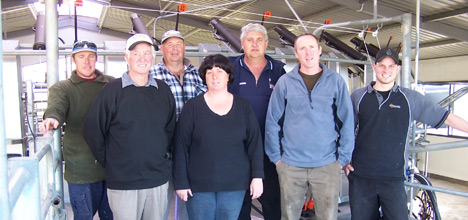
For a long time now, I have been driving past the Fox shed on a weekly basis and in it's various stages I have admired the progress from old shed to new shed.
Back left to right: Stephen Vierboom, Shane Boyce, Gordon Faber, Kevin Mathis. Front left to right: Jim Fox, Wendy Boyce, Stephen Smith.
The new shed was being erected at the end of the old yard and shed; so was being constructed in phases and all the while the herd was still being milked in the old shed. After such anticipation I was not going to let any other reporter cover this one.
Jim and Diana Fox own the farm, which is share-milked by their daughter Wendy and her husband Shane Boyce.
Jim and Diana moved to Thornton from Papamoa back in 1973. They had three children when they bought the farm. Back then they had a 21-aside herringbone shed to milk their 245 cows through. Cow numbers increased over the years to 300.
'I couldn't get my wife near the cowshed,” says Jim with a hearty laugh, 'so I employed farm labour for starters, then moved up to contract milkers, then my son went 50/50 share-milking for me. When my son passed away, my daughter Wendy, and her husband Shane carried on the 50/50 partnership.”
'If Wendy and Shane hadn't come along at that time, we would have probably moved away,” says Jim.
On July 17, 2004, floods hit the plains and that was a very stressful time for the farming enterprise. The farm was under water for at least a week, but it was all their own water contained within the flood-pumping scheme.
'Because it was July it didn't affect the season too greatly,” says Jim.
'It was still pretty hard going for the cows calving though.”
The farm consists of 110 hectares, with a 60 hectare dry stock unit at Manawahe.
One of the ‘big things' that occurred after the 2004 floods was that the local council brought in requirements that the new farm dairy had to be 2.20 metres above sea level. As the building site was only 1.16 metres above sea level it meant some building-up of the site prior to commencing building.
Because of council requirements, it made the decision to build a rotary rather than a herringbone shed; a big factor.
'We didn't want a pit being built down too low,” says Wendy, 'so we decided on a rotary, which will also allow for one man milking after calving.”
Planning and Architecture
Don Chapman originally met with Jim Fox, Shane and Wendy Boyce, and builder, Maurice Savell to discuss how they might go about constructing a new dairy on their farm.
A couple of sites were looked at, but they always seemed to come back to pretty much the existing dairy site. This was because of the slight elevation of the site above the surrounding plains; bearing in mind potential floods and also effluent disposal. The farm infrastructure was already centred on this site and it minimised the cost of new farm racing, tanker track and power supply.
It offered some challenges in the form of the existing dairy and the need to work around this while the new dairy was being built. A way was found and Chapman Dairy designed the new milking parlour and yards to suit. This new dairy was custom designed, building on all the strengths of the Chapman Dairy building system: great cow flow, light airy building, with low maintenance and easily cleaned building materials.
Maurice Savell built the new dairy while the Boyces milked their cows in the adjoining dairy. In early February this year they moved to the new rotary, arranging a temporary entry and exit to the rotary platform from the existing yard.
Maurice's death early in the year meant that after the cows were finished milking, Steven Smith, who was working for Maurice, came in and demolished the old milking shed and built the new yard over the site of the old dairy.
Don Chapman has been building farm dairies for over forty years now. For the last 20 years building under the name of Don Chapman Builders. In recent years Chapman Farm Dairies have been built in other areas of New Zealand and it has become necessary to separate the farm dairy side of Don Chapman Builders from the other building work the company does. Earlier this year ‘Chapman Dairy' was set up to bring a number of different licensed builders of these dairies in different areas of NZ under the one umbrella. Along with this change the company has pursued some overseas opportunities and have now formed an alliance with an Irish company to construct Chapman Dairies in Ireland and the UK.
Although Maurice Savell commenced the building work on the Fox's new dairy shed, it was an unfortunate turn of events that led to Stephen Smith taking over the reins far earlier than expected. Stephen had worked for Maurice for many years, with the intention of eventually taking over the business when Maurice retired.
This happened sooner than expected due to Maurice passing away suddenly.
Stephen currently employs one worker, but when he starts his next dairy shed he will employ another to help carry the load.
Smith Builders is contracted to Don Chapman and have constructed three Chapman sheds in recent times in the Whakatane district.
'Don's guys came in and did the structural steel girders and we took over from there,” says Stephen.
'This build probably took around four months to complete,” says Stephen.
'We had to work around the milking in the old shed, so had to wait until the old shed was pulled down to build the new yard. There was a gap of a couple of months so we started a new shed just down the road.”
Stephen and his worker, Stephen Vierboom, built the entire shed after the steel work had been done. Smith Builders also erected the poly panels, laid all the concrete, set the initial pipes into the concrete for the yard and laid all the block work.
Tracks Concrete from Whakatane supplied concrete.
Jim Dippie from WJ Dippie from Taneatua came in and welded all the yard and pipe-work.
Owen Barlow Roofing put all the roofing in place and because it was sub-contracted to Don Chapman, Owen got to do the roofing for all of Don's projects.
Refrigeration
Gordon Faber from Independent Refrigeration in Whakatane installed the refrigeration unit for the new dairy shed. The refrigeration unit is built with heat recovery.
The milk is in the vat at five to six degrees after coming out of the cow at 37 degrees. The milk goes through a one stage cooling, before a one-stage snap chilling, then into the vat at five to six degrees.
Gordon also installed the vat controllers, as well as doing all the electrics for the chiller units.
Wiring the shed
Horizon Energy made numerous visits to the dairy shed to install the wiring in stages throughout the construction. As each section of concrete was laid, Horizon staff had to have the electrical cabling in place prior to each concrete pour.
Three sumps were put in place to begin with, two in the shed, and one out by the drafting area. Kevin Mathis from Horizon Energy explained that there is no longer a lot of surface work in new dairy sheds, it is all underground.
All the underground pipe-work runs back to the main switchboard.
At times there was a crew of four men on the job from Horizon Energy. Before the old shed was fully demolished, the power had to be changed over; as morning milking was done in the old shed, and the afternoon in the new shed.
Jim says that he had to have discussions with Fonterra and Qconz prior to Horizon Energy increasing the voltage from the main transformer.
There is a generator backup with this shed so that in the event of power failure, the milkers only need to go out to the generator and flick a switch to run the entire milking system, effluent system and refrigeration. This generator takes over the whole running of the shed, until power is restored.
Plant Installation
Liquetec Farm Services from Edgecumbe, are the Milfos dealers for the Eastern BOP area. This new 44-bail open centre rotary dairy shed has some of the latest Milfos technology available to farmers in the dairy industry.
The Integra bail cabinets, located on the outside of each bail, house all the automation, sensors and electronics behind a stainless steel front cover.
This separation allows equipment to be kept clean and protected from the harsh milking environment. With Integra bail cabinets, servicing the equipment is effortless. The main items in the cabinet are the automatic cup removers, the Intelscan Plus controller, which controls the milking process, pulsation and ACR's. It also has a highly accurate milk yield indicator and dataflow system for full milking and herd management.
This cabinet also houses the clip in jetters when not in use.
The platform has a cow restraint system, which drops down behind the cow when the cluster is attached. This keeps the cow on the platform if she has not finished milking out.
Labour requirements are vastly reduced at the cups off area because of this.
There is also variable pulsation, which allows the pulsator rate to be matched to the milk flow for increased milking speed, stimulation, which detects those cows that have not let down their milk and it delivers a high frequency vibration to the liner around the teat to induce the let down hormone oxytocin.
The milk pump system is controlled by the Intelcentre and has a variable speed centrifugal pump with a purge valve to enable the recovery of milk left in the system at the end of milking. The valve is opened to inject compressed air into the system which transports the milk to the bulk tank.
The vacuum system features the Milfos Irotavac 4000 vacuum pump. The pump is based on a tri-lobe principle. The lobes are rotated at high speed to create a continuous and stable airflow. Fine pump tolerances ensure the lobes never touch and therefore they do not require any lubrication. The vacuum pump is controlled by a variable speed drive, which alters the speed of the pump, according to the demand the plant requires through a sensing monitor on the main airline.
The shed also has an automatic drafting system incorporating an auto teat spray system.
The automatic wash system cleans the plant at the end of milking. This has a variable wash programme that can be altered to suit any type of plant. It adds chemicals, will do hot, cold and warm washes, recycling, as well as turning the plant off at the end of the wash. The auto wash system is very precise, and takes the ‘hit and miss' out of the cycle.
The platform is installed with Wetit Waves, which keeps the cows legs adequately separated for easier cupping, and alleviates the cows kicking also.
The end result
In conclusion, Jim Fox is thrilled with his new shed. He is elated with the way everything turned out and the ease with which all the contractors involved worked together.

0 comments
Leave a Comment
You must be logged in to make a comment.