


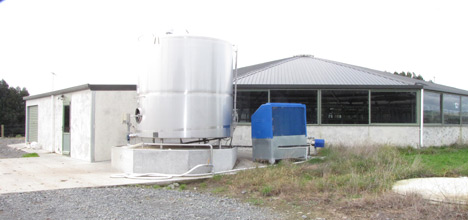
Herd manager at the Johnstone shed in Otorohanga, Brett Jordan, says he has noticed a big change since the new shed was built.
'We used to milk 1050 cows through an old 40 bail internal rotary and that used to take about five and a half hours. Then we built this shed as a sister shed, and we've built this up to where we are milking about 700 through here in just over two hours. It's a one man shed so you can just do a herd each.”
The new shed is a 60 bail rotary and Brett says it is a lot easier to milk in.
'The platform is higher than the old shed, which makes milking a lot more comfortable for those who are a bit taller, and it is also easier to use generally and easier to clean.”
The hardware
The milking machine and the refrigeration equipment were installed by Qubik Otorohanga.
Kyle Osborne of Qubik Otorohanga says they installed standard Waikato Milking Systems components including a 2.2 kilowatt milk pump with variable speed control for better milk quality and improved milk cooling.
The Waikato blower vacuum system, with variable speed control, can produce vacuum on demand which saves up to 47 per cent of the power to run the vacuum pump motor.
They also installed an Arctic Blue chilled water system which cools the milk to about 5C before it enters the vat.
'From there the refrigeration unit only has to maintain that temperature,” says Kyle.
At the other end of the scale, Qubik Otorohanga also installed a Mahana Blue hot water system that supplies four and a half litres of free hot water at 85C every minute that it is running.
'It was a nice straight-forward job for us. Peter was clear that he just wanted the set-up basic and not a lot of whistles and bells.”
Saving milk
The Waikato Ultimate electronic cup removers with autostart make the cluster application a one handed operation and the milk recovery system saves milk by purging the delivery line after milking. And speaking of the clusters, the shed was fitted with Waikato 320 claws with stainless steel tops and longer nipples to make them more robust and G2 cluster washers. The G2 cluster washers have individual non return valves on each cup, improving their overall performance.
The Waikato NT24 electronic pulsators operate two sets of clusters each. Milk is filtered by a Waikato Maxi milk filter which can be used with single use paper filters making it very economical. Cleanliness is ensured thanks to the Waikato slugwash cleaning system.
Project management
The lead contractor on the Wallace Johnstone shed was Dairy Tech of Otorohanga. Dairy Tech directors Peter and Diane Gray have been responsible for building a great number of new dairy sheds over the last few years. They took care of the design and arranged the sub contractors and supervised the entire project.
All the electrical work was done by Te Kuiti firm Waite Electrical and the effluent and water reticulation was put in by Otorohanga firm, Dairy Systems Engineering & Pumping Ltd.
Matthew Hoyle from Aztech Farm Buildings built the calf sheds.

0 comments
Leave a Comment
You must be logged in to make a comment.