


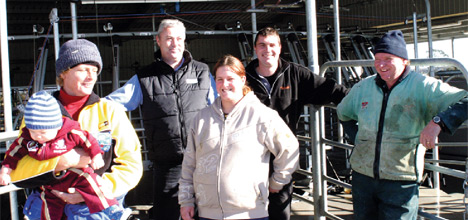
A piece of New Zealand dairying history had to make way for Doug and Penny Storey's new rotary dairy shed.
Front: Cruise Jackson, Niki Smith, Monique Jackson, Gary Smith. Back: Paul McGill and Jason Hare.
He used to milk out of two 12-a-side herringbone sheds set up to operate out of the same yard.
The cows walked up the same ramp to the herringbone and walked down a ramp as well when they exited, says Doug.
'It was the bee's knees at the time,” says Doug. 'Ruakura did a time and motion study on it.”
The herringbone was built on top of an even earlier walk-through shed, the foundations of which could be seen until the recent demolition of the old sheds and yard.
'There was a lot of history there,” says Doug.
'We knocked it over and turned it into an orchard. It's time was done.”
The new shed has also brought about the amalgamation of the two herds that were milked through the herringbones and another 14-a-side herringbone shed about a kilometre further down Woodstock Road.
The new shed is about 100 metres downhill from the old site, still right in the middle of the farm. Half the herd is grazed down on the flats, the other half of the grazing is accessed by the underpass beneath Woodstock Road, just west of Te Awamutu.
Doug says he's milking over about 165 Ha.
'It's always changing,” says Doug.
'We grow all our feed, maize silage, on the farm, but we do buy in a bit of palm kernel.”
The new shed's been on the drawing board for ten years. Originally it was envisioned as a larger herringbone shed.
They looked at a few sheds before making a decision, says Doug.
The decision to go rotary was helped by his father having one built the year before, so he had a good look at how the technologies are progressing.
His builder, Pat Gibson, is based next to Qubik TMC in Te Awamutu, in the same building.
The builder and plant installer work together on a lot of sheds so there is good communication about systems installation.
'It's just all tying everything in its place where it should be; drainage, electrical, ducting for this and that,” says Doug.
'All the levels have got to be right.”
The effluent pond is gravity fed from the shed. It used to be a two pond system.
'We converted that into one pond and put in a big pump and stirrer down there. It's all sprayed round the farm with the travelling irrigator,” says Doug
Spreading the effluent with the former system was a two tractor and really, a two man job. Now it does its thing at the press of a button.
'Now it's a one man job that's very easy to do.”
A range of other farm tasks have also been made a lot easier by the electronics and management systems.
Gibson Rural Builders has been building dairy sheds for at last 10 years. 'We built one for his father the year before,” says Pat Gibson.
'It was based on that, but Doug's is just a little bit more up market, a few more trimmings.
'There are three plans we use, and that's one of them,” says Pat.
His sheds are all rotary designs. All concrete floored and steel framed with Colorsteel trim clad.
'The farmers normally make minor changes to it, in Doug's case he's coming in through the side,” says Pat.
From his point of view dairy sheds are pretty much the same, with the main differences depending on who builds them
'They've all got certain features that you have to have. It's just a matter of what you actually decide on.
'We do most of our work with Qubik TMC and Waikato Milking Systems.”
For their customers it means there is a one stop shop where they can make their design decisions and then leave it to a team that is used to working together.
'The farmer gets a look-in at the start and then we don't need to see him until he starts milking,” says Pat. 'Unfortunately it doesn't work that way.”
But with the Gibson-Qubik collaboration Pat says they could do it with confidence.
'We normally use the same sub-contractors on each job; at least we try to.
It is smoother to get through the process; it's easier to do the project as far as the farmer is concerned.”
Doug and Penny Storey have been dealing with Qubik TMC since it was known as Te Awamutu Milking Machine Company Ltd.
'The Storeys are a long-standing customer of Qubik's,” says Jason Hare from Qubik.
'The old shed that was over there, we used to service that as well.”
In the new shed, Qubik TMC has installed a variable sped blower vacuum pump and a variable speed drive with wash down pump.
As part of the plant installation, Qubik also installed the vat wash and plant wash down systems and the Mahana Blue refrigeration and hot water system. The Mahana Blue unit produces hot water at 85C at four litres a minute, which is stored in three 450 litre hot water cylinders.
Outside the shed, Qubik also installed the new effluent management - the pontoon, a bridge and pump, and put in a new bore. The pumps are all Dab.
Qubik installed a 50 bail Waikato Milking Systems rotary. The platform is built by Rotary Platforms New Zealand Ltd, a wholly owned WMS subsidiary.
All the stainless steel pipe work is by another WMS owned company, Hamilton based Stainless Innovations.
The platform uses stainless steel rollers for longevity, they seem to last longer and seem to be stronger, says Waikato Milking Systems area manager Paul McGill.
'We looked at nylon rollers years ago but we found the steel rollers just stacked up better,” says Paul.
He recalls one shed with nylon rollers had to be started each milking with a tractor because the weight of the platform ‘squared' the rollers and the drive motor couldn't cope. Once it began moving the nylon was squashed into shape and kept the platform moving – until the end of the milking.
'These platforms are designed to accommodate all the Waikato Milking Systems gear,” says Paul.
'All the bracketing on the platform is specifically designed for WMS systems.”
The Storey shed also has the New Zealand designed Wrangler and the New Zealand designed Wettit teat sprayers. One of the few aspects that are not New Zealand designed and built is the herd management system.
The key information gatherer for the management system is the Israeli designed pedometers strapped to each cow's leg.
The pedometers supply cow data to Waikato Milking Systems Frontier Herd Management system, which Paul says is a step above the normal plant.
It uses a combination of milk yield and cow activity to determine cow health, the response to feed changes, and identify cows that are in heat or are lowering output.
The system, records milk conductivity, milk volumes, weighs the cows and automatically drafts to pre set parameters or cow numbers.
'All this is based on a computer set in the office with the software programme loaded so the guys every day get a recorded milk volume, the weight, heat, and activity,” says Paul.
When a cow's on heat the system will record a spike in activity compared with the herd average. That information can be compared on screen with her milk production and if there is a drop at the same time you have an in-heat cow, says Paul.
The Frontier system is now in 50 different countries and is widely recognised as the leading herd automation herd management system, says Paul.
The plant's automatic cup removers are also integrated with the management system.
'An error code or something like that won't let you put the cups on,” says Paul. 'If there is a cow that has high conductivity over the last few milkings it will give you a code.
'If it is indicated by the system that a cow is not to be milked due to high conductivity, the management system will stop vacuum to that cluster.”
Corboy earthmoving dropped the old shed and used the remains to build up the tanker track across to the new shed site.
The new shed required a new track in from the road, new races and feedpad.
'It wasn't too bad because the races came up past here anyway,” says Brent Pevreal.
All the metal and aggregates were obtained from Austin's Quarry Te Kawa.
'We have done a bit of work with Pat Gibson from Gibson Rural and we have done quite a few sites for him.”
Fencing is by Tipping Agriculture.
The milkers are Gary and Viki Smith who are the contract milkers at the Storeyline shed.

0 comments
Leave a Comment
You must be logged in to make a comment.