


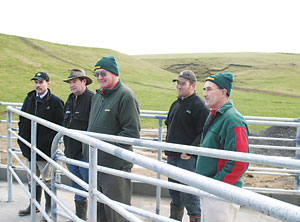
The snow that fell on the ground during the construction of the Pedersen dairy conversion may now have melted but it still remains fresh in the minds of those who worked on it.
| Philip Wilcox, Charlie Pederson, Martin Telford, Karl Parker and Colin Nichols inspect the progress. |
The shed's location on a plateau off State Highway 49 between Waiouru and Ohakune means snow is a fact of life and has dictated some of the design.
The weather also gave Farm Supplies Central workers installing the milking plant something to moan about over the winter. Their boss Brian Ebert says the crew installing the plant were staying in an old farm house on the property and at one stage working with nearly 50cm of snow on the ground outside the then unheated building.
It is a big shed. At 17m wide by 32m long it is big enough to put a roof over the 60-bail rotary and the vats.
'We've housed the vats and everything inside the building because most winters there is snow and it is not unusual to have some in spring,” says owner Charlie Pedersen, former Federated Farmers president.
'We thought it better to have everything inside. It is quite a big building.” It is also built stronger than normal to carry the weight of snow on the roof, which has been made with chiller panels, so the shed is well insulated and they can milk in spring snow if they have to.
'It does keep it cool in summer. Apart from that it is completely standard.”
The completed shed interior will have a Surfatex Coating.
The milking plant is a Milfos IFLOW 60 bail rotary platform with the upgrade to hydraulic drive units to allow the rotation during a power outage by coupling the tractor to the hydraulic unit. Nylon rollers support the platform for smooth running without any bearings to maintain.
Other key components of the shed are the variable speed drive on the milk pump and vacuum pump to minimise noise, reduce wear and tear plus give a pay-back through reduced power consumption. The milk line is fitted with a purge system to clear all the milk into the vat before wash and between herds. Milfos ICR cluster removers are fitted to ensure the cows aren't over-milked. Bail restraints ensure any cows that kick the cups off will be retained on the platform and brought back to the operator. The platform and plant were installed by Farm Supplies Central Ltd.
Charlie's cowshed has got the retainers for cows going round twice, cup removers, and the iC 330 claw.
They are in the Milfos middle range, but are top of the range when compared with the competition, says Brian.
'They are pretty bloody clever.”
The systems being installed in the modern 1000 cow dairies are also changing farm management.
The milkers can be alerted to variations in individual cow performance. The individual animals can be drafted for assessment from on or off farm. It is a total management package that Brian says he is seeing more and more of. 'It means you don't have to have your experts milking cows all the time. They can be managing the site or be hands-on.”
Farm Services also installed Charlie's wash down system, a Technifarm Dungbuster that uses jetting guns in the yard rather than flood wash.
The management system is MilkHub, a New Zealand design offering on-line and in-shed herd management, drafting and feeding.
MilkHub uses radio frequency identification (RFID) chips to monitor every cow, every milking, detecting cows with mastitis and cows with low yield.
These cows are ranked to allow the worst cows to be drafted during milking.
MilkHub also monitors the plant during milking and cleaning. Plant abnormalities are identified so faults can be cleared to ensure optimum milking efficiency. Poor cleaning is identified so operations can be adjusted to ensure proper plant hygiene. MilkHub also integrates with drafting gates, walkover weigh scales and feeder systems, allowing these to be controlled either from the shed or remotely via the web-based management system.
Charlie has started out with the management system and a view to future upgrades, managing director Dr Ross Nilson says.
Unlike other systems MilkHub was designed from the top down, from a clean slate. Ross says it grew from the dairy industry's need for an efficient and effective mastitis detector. Rather than taking an incremental development approach based on existing agri-tech products, a different method was adopted drawing on experience from telecommunication product development.
The approach was that any unnecessary complexity, maintenance or user interaction would inevitably lead to the equipment falling into disuse. That key aim set the direction for the design of the technology and the user interface.
User input is minimised by having an always 'on” automated operation. The idea was to identify and rank cows by infection severity and allow for drafting during any milking via a single step.
The technology includes a flow-through manifold with high-flow and low-flow pathways. Precision measurements are made on the low-flow pathway where the milk is free of entrapped air. Patented high frequency electric field techniques, together with other sensors, are used to get instantaneous measurements through the plastic containment walls.
'We spent a long time on the sensors,” says Ross, whose doctorate is in electro-chemistry.
'This system has got the legs and arms to make a practical difference in the shed.
And the on-line management system means you can access it from anywhere.”
Starting from first principles has flowed through to the in-shed controls, which Ross says are designed to be simple and easy to use, because in the shed the milker has about 10 seconds per cow.
MilkHub sold its first design two years ago, and is now receiving enquiries at a farm a month.
'It is finding its place in the market.” Charlie says the MilkHub system was superior to anything else they had seen.
'One person should be able to milk 1000 cows quite comfortably.”
With the Reporoa Engineering backing gates on pulse control, he's expecting good cow flow.
The dairy block of about 728.4ha stretches from the Whangaehu River and the military airfield to the highway, with the cropping land on the other side of the highway.
It appears hilly from the road, but plateaus out to easy country that is now fenced for dairy paddocks. The largest area of flatland is right beside the military airfield.
Charlie points out the gate to the military block, shaking his head. It was being eyed by staff and others with a view to testing out some of the vehicles on the more than 3.6km fully sealed runway.
About 404.6ha is involved in the conversion.
The shed is 2.5km towards the mountain from SH49. Tenix Alliance NZ Ltd extended an existing 11kv line about a kilometre to the shed site, and installed the lines company's transformer.
On the western side of the highway there is about another block used for growing winter feed – 80ha of triticale and 60ha of swedes.
'It grows good Swedes,” says Charlie.
Charlie's home is at Himatangi. They looked over the Waiouru property in August 2007 with the idea of expanding. For 30 years it has been a sheep and beef unit.
'We were looking to buy a sheep and cattle farm but after buying it we looked at it again,” Charlie says.
'Half the farm is very flat even country, ideal for dairy farming. The intention is to milk 1000 cows, grass fed in summer and wintering over on swedes.”
Not all the land is dairy. Two reserves have been created by fencing off the steeper bits. Twenty seven hectares of red tussock are now the Parker Gully Wetland. The reserve surrounds a former stock pond, home to a pair of Dabchicks or weweia, of which there are less than 2000 remaining.
The slopes from the dairy flats down to the Whangaehu River at the northern end of the block will also become reserve. They are covered in scrub at the moment. The advice from DOC is to use a helicopter to spray it and the native vegetation will come away.
'We had an ecologist come in and do a survey of the place and we will be using some of his advice about what to do. We haven't done everything he said, we still have to farm.”
The Waiouru block will be run by Karl and Erica Parker, Charlie's son-in-law and daughter. Karl's having an interesting year with a change in career from sales management to farming and also becoming a parent for the first time.
'He's just having a great year,” says Charlie.
'He'll have good staff under him.”
Before dairying and parenthood, Erica was a rural valuer with Quotable Value NZ.
Their new house will overlook the shed, and have views of Mts Ruapehu and Taranaki.
It is the mountain that brought Charlie to the area. He's a keen skier and he and wife Chrissy are now looking for something else not too far away.
'We are probably going to shift up here as well. We have been thinking about it and looking for another bit of land. My son is running the home base. We could both get out of his way and carry on farming sheep and cattle up here.”
In late July the shed was all but finished.
'Construction started after new year, after the holidays in January, so it's been quite slow,” says Charlie.
'Then the cows went and started calving, drawing most of the people working on the contract away to build calving sheds.”
With the sheds built and calving started, heavy rain in late July washed mud over parts of the track, and delayed the vats from being carried up the hill.
He loves the soil on the new block. At Himatangi it is sand. At Waiouru there is a layer of topsoil over pumice and volcanic soils.
They are starting with three full-time staff and a couple of part-timers.
Philip Willcox from the National Bank in Palmerston North is Charlie's banker at Himatangi and Waiouru. He says the customers get started on a development project by doing a plan.
'We get started off by coming and having a look and get and idea of what the property is,” says Philip.
'Then it is what it's going to look like in the first season - pretty much now - and where it's going to get to as a going concern. It makes it an exercise in cost-benefits.”
The other essential is a dollar per kilo figure for the return, and the scale.
'Once you get to the scale you should have a profitable outcome.”
It helps to base the return on a number that is known to be sustainable year in and year out.
'Make sure you have got a plan in place and some numbers – and make sure you do your homework.”
As it is a moving target, it also helps to have sharp people on site.
Colin Nichols from Farmlands Palmerston North has made several trips to Waiouru hauling trailer loads of piping. Charlie's a Farmlands shareholder and has dealt with the Palmerston North Farmlands through the Himitangi farm.
Farmlands Palmerston North supplied most of the piping for the conversion's water reticulation and effluent irrigation.
'At a rough estimate that is about 17 kilometres of water pipe in several different diameters and pressure rates, and about 3.5 kilometres of effluent piping. The lot of it is underground,” says manager Martin Telford.
'We facilitated it rather than designed it. Karl installed it. The way it worked out there were some fairly tough time frames. When something was needed, it was needed.”
Farmlands Trading Society Ltd is a co-operative owned by the shareholders. 'So if the customers act like they own the place, well they do. At the end of the year, any profit belongs to the shareholders.”

0 comments
Leave a Comment
You must be logged in to make a comment.