


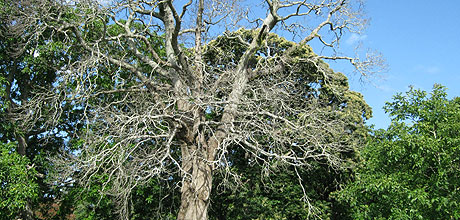
A Tauranga City Council arborist is confirming that trees do indeed die of old age after a chestnut tree in Waipuna Park died of natural causes.
Richard Conning says the tree is dead and is going to be removed from the park in the next two weeks.
The dead chestnut tree at Waipuna Park is marked for felling.
'Most likely it's old age,” says Richard.
'That walnut grove was established in the 1890s and those chestnuts and those larger trees are of the same sort of vintage.
'As far was we are aware it is natural causes, I'm not aware of anything untoward with that – it does just happen, trees sort of get old and die.”
There are two chestnuts in Waipuna park. The neighbouring tree is still alive.
Richard says chestnut trees in Europe live for several centuries, but little is known about their longevity in New Zealand.
'Because New Zealand's such a new country, we don't know how long different exotic species last – we haven't been in the country long enough to find that out yet.”
He's expecting, because the tree has died, that there will be some decay in the wood, which may make it unsuitable for anything other than fire wood.
'Quite likely the real big stuff that people can't handle, Abor Care will just take that away.
'If there's firewood, Arbor Care will leave it out by the roadside for people to take if they want.”
Chestnuts have been grown commercially in New Zealand since the 1980s.
One of the industry pioneers, Ray Knowles, remembers the Welcome Bay chestnuts from an inspection he did of the country's old chestnuts in the early days of the industry.
Ray says the dead tree is a European chestnut that has probably died of root rot.
Its neighbour is a Japanese chestnut, which is more resistant - and still alive.
'If it suddenly curled up and died within 12 months, that sounds like root rot.
'It will be interesting to see what the inside is like. Back in Europe they are a renowned timber tree and people have asked ‘how good are they in New Zealand?'”
'It's a bit hard to tell with open grown trees because they are not treated as a timber tree as such.
'They are not pruned and old branches get ripped off in storms and let the rot in, but who knows? – If it's solid inside I would be interested to know.
Chestnut trees in the northern hemisphere can live for 1000 years, but in New Zealand they are lucky to survive to 150, says Ray.
'A lot have expired when they get to that age. If it's not root rot that polishes them off it's storms, general decay and decrepitude all round.
'They grow a lot faster here, about 10 times the rate of what they grow in Europe.
'If they are growing in a hard site, the South Island or up in the middle of the North Island somewhere, they would probably last a lot longer, but the tree size would be a lot smaller as well.”
Ray says growth rates are a reflection of growing conditions and Welcome Bay is a 'paradise for plants” with its deep soils, mild climate and high rainfall.
'Things just go berserk. The downside is that I don't think they live as long.
'Phytophthora is the name of the nasty that finished it off, that would be my guess.
'There's a whole range of those things and that is probably also most likely the culprit that is finishing off our Kauri trees now.”
Phytophthora also kills potatoes and tomatoes and there is a variety, which Ray says is common in the avocados.
'The same one that knocks off avocados is the same one that knocks off chestnuts, so blame the avocado guys.”

1 comment
Leave it to the experts
Posted on 22-01-2012 21:19 | By Kimberley
It's always good to hear from the experts. The trees in Tauranga are a lovely aspect of our city.
Leave a Comment
You must be logged in to make a comment.