


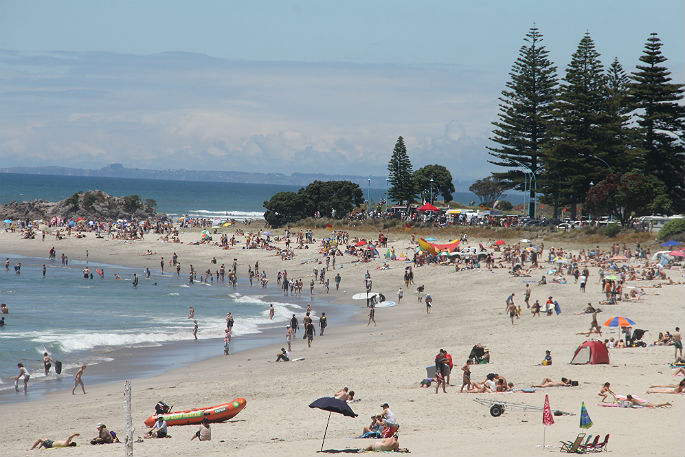
It's not just people in the Bay of Plenty, Marlborough and Nelson enjoying a sunny climate these days.
Nearly all of us are.
During the past four decades, New Zealand's annual hours of bright sunshine have crept higher, further fuelling the annual competition - often between Blenheim, Nelson, Richmond and Whakatane - to be named the country's sunniest location.
Scientists were initially unsure how much of that rise might have been due to using more modern, and possibly more accurate, instruments to measure sun.
National Institute of Water and Atmospheric Research (Niwa) atmospheric scientist Ben Liley said after analysis it appeared most locations in New Zealand were getting on average about two hours more sunshine every year compared to the previous year, or 20 hours more every decade."The rise is real."
According to the Ministry for the Environment and Statistics New Zealand, yearly sunshine hours have gone up at 27 of 30 selected sites since 1972.
"The patterns of cloud cover are changing as our climate changes. As storm tracks and sub-tropical dry zones shift poleward, less cloud cover and more sunshine is expected in the future in the mid-latitudes," the agencies' Environmental Indicators report said.
Last year, wider Nelson was New Zealand's sunniest place, with 2555 hours of bright sunshine.
Of the six main centres, Tauranga was the sunniest, with 2314 hours of sun. Auckland, Hamilton and Christchurch had 2041, 2029 and 2017 hours respectively, and Dunedin recorded 1946 hours. Wellington was the dullest, with 1900 hours.
Ben says there had been considerable debate about whether the accuracy of traditional, card-fed Campbell-Stokes sunshine recorders compared with new electronic sunshine sensors was hiding the truth of any real rise in sunshine hours.
"It is very easy to say a burnt track on a piece of paper won't be nearly as good as an electronic instrument. But in fact the data are reassuringly consistent."
Sunshine hours had always been a contentious issue, with several towns and cities and councils in Marlborough, Nelson and the Bay of Plenty vying fiercely for the title of "New Zealand's sunniest", he says.
"In that context, Niwa has assisted with the interpretation of any apparent anomalies, and we check the performance of the electronic sensors against our reference instruments here at Lauder."
The Environmental Indicators report said, on average from 1972 to 2013, parts of Northland, the Bay of Plenty, Gisborne, Hawke's Bay, Nelson, Tasman and Marlborough had high annual sunshine of more than 2250 hours.
Over that same period, Auckland, Christchurch and Wellington had relatively high annual sunshine, between 2000 and 2250 hours.
However, parts of the Southland region and the Southern Alps had low annual sunshine, with fewer than 1500 hours on average.
-Stuff.co.nz/Paul Gorman

0 comments
Leave a Comment
You must be logged in to make a comment.