


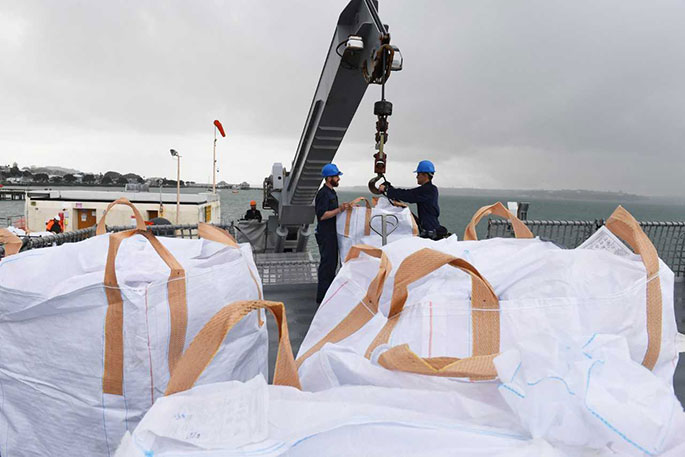
The New Zealand Defence Force is taking about eight tonnes of supplies to the Kermadec Islands this week to sustain scientific work in the remote islands over the next six months.
Commodore Tony Millar, the Maritime Component Commander, says offshore patrol vessel HMNZS Wellington would take equipment and supplies necessary to advance the work of the Department of Conservation (DOC), MetService and GNS Science during the second resupply mission to Raoul Island this year.
'These agencies undertake work that is important for conservation and in monitoring global weather, tsunamis and other geohazards.
'Our Defence Force's transport and logistic support has been a vital lifeline to these agencies, enabling them to continue their work despite the remoteness of the Kermadecs.”
Lieutenant Commander Damian Gibbs, the Commanding Officer of HMNZS Wellington, says 19 scientists and support personnel, including a new rotation of DOC staff, would be joining the 1000km trip.
On its return, the ship is bringing back 3.5 tonnes of equipment that had been discarded by DOC.
'Our crew members are experienced in operating in austere environments such as the Kermadecs, whose lack of natural shelter pose particular challenges for those operating there.”
Steve Knowles, MetService's Network Observations Manager, says four MetService staff would carry out maintenance work on the automatic weather station on Raoul Island, which reports weather conditions to forecasters based in New Zealand.
They would also train DOC staff in releasing weather balloons, which were used to forecast global weather, says Steve.
'All this meteorological data received from Raoul Island makes a significant contribution to global weather models and is essential for tracking tropical storms in the area.”
Three members of GNS Science will install a new satellite dish on Raoul Island to improve the communication of geohazard information to mainland New Zealand and carry out maintenance of the GeoNet project's monitoring equipment.
GNS Science volcanologist Brad Scott says the new equipment would significantly enhance timely transfer of data and improve response during a hazard.
'The Raoul Island site is critical to GNS's monitoring capabilities because it is often where Pacific tsunamis make their first landfall.”
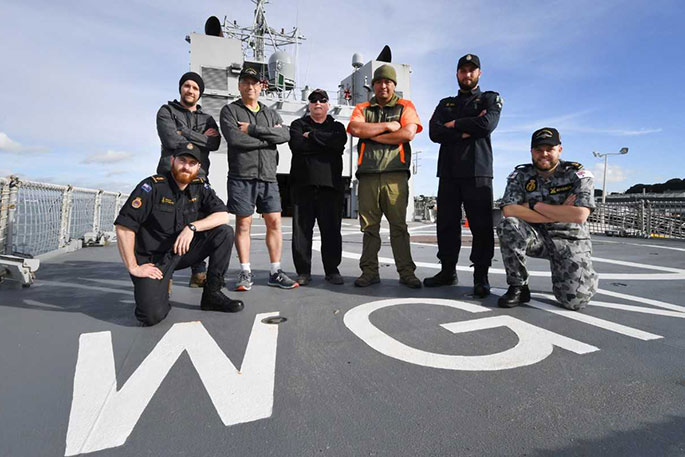
From left, Kris O'Brien from GNS Science, Steve Knowles from MetService, Murray Bowden and Matiu Mataira from the Department of Conservation with sailors from offshore patrol vessel HMNZS Wellington before they sailed to the Kermadec Islands this morning.

0 comments
Leave a Comment
You must be logged in to make a comment.