


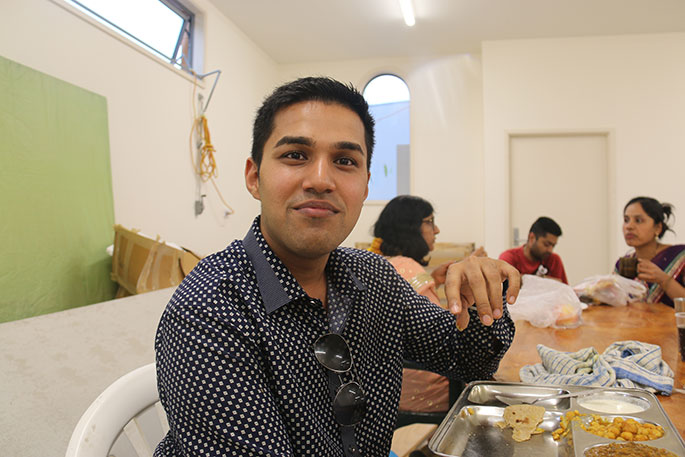
I met Gary Sailey at one of Tauranga's Hindi celebrations. He saw me sitting alone among the large gathering of people and came over to say ‘hi', which is, I've discovered, a great way to start getting to know someone.
Gary started life with cerebral palsy down his right side. Undeterred by this he threw himself into school sports. His spirit was limitless and he was determined to become a Black Cap.
'As a little kid I wanted to represent New Zealand,” says Gary. 'But I didn't know my limitations. As you grow up, you realise something is different. Kids started asking me questions like ‘we're faster than you, how come you are slow?'”
His family sent him to India for two years to get his arm stretched out. Daily he underwent electrical shock therapy with his arm pulled out for 15-20 minutes.
'At one point three people were pulling and holding my arm for an hour. It was very painful.I went through a period when I felt very low and depressed. Cricket was my life.”
His grandfather Mohan lal Saily and great-uncle Jatinder pal Saily took care of him in India with parents Roman and Raksha Saily supporting him through this difficult time.
Gary had attended Selwyn Ridge Primary School and loved being involved in sports.
'We used to have the school cross country at Waipuna Park,” Gary recalls. 'The teacher would ask whether I wanted to race. I knew I'd come last but I said ‘I will race'.
'The thing was to be part of everyone. To not feel different. If you start feeling different then you start being treated different.
'At the end everybody would start yelling out my name and clapping, and that would give me that extra kick. It was an amazing feeling even though I was coming last.”
He remembers finally not coming last in a race at Tauranga Intermediate.
'There were four of us who couldn't go in the cross country. We walked to the finish line and I sped up a bit because I suddenly realised this was my big chance to not come last for the very first time! The teachers were even laughing. They were happy and cheering.”
I asked him why he'd chosen to come and sit next to me.
'I felt that you might be feeling left out because everyone else was talking in their own language. So I got my food and came to talk with you so you'd feel comfortable.”
He was 17 when he was sent to India to get his limbs straightened.
'I knew if I failed, my grandfather would help me because that's the trust and bond we have. Whenever I felt down he was always there to help me.”
The pain was so intense that he often felt like giving up.
'I found other people there who were very positive. One lady carried her 15-year-old child on her back every day because he couldn't walk or catch the bus to get there. She had a sparkle in her eye, and was always happy and smiling.
"He had cerebral palsy on both sides, couldn't talk and was also mentally unstable. When I saw her, it opened me up. These guys are so positive - why can't I be positive? It started changing my outlook towards life.
'My grandfather told me that if I give up now that there might not be another time. And so that's when I realised I need to be proud of myself no matter what happens. A lot of ‘what ifs' go on in your mind – ‘what if I'd stayed?' So I realised it was now or never.
"I decided I'm going to live life because what's the use of being depressed over something that's going to last 15-20 minutes?
'In India I got about 70-75 per cent better and when I returned it was a really big thing. Everyone was very happy for me and I felt like I was finally being treated like a normal kid.”
He returned to college when he was 19 but found it took some time to get used to feeling more able-bodied.
Reflecting on life, he recognises the value of building relationships with others.
'When you do that, you start feeling good. That's what I did.
'Because the government cares for us and makes sure everybody's treated well, we can have bigger expectations because life can be too easy. In other countries you have to fight for yourself.
"If you don't, nobody cares. I found with that attitude people are so much more positive. You learn that you have to take care of yourself.
'I realised not complaining all the time is how you live life. And building relationships. The pain was still there but it didn't affect me so much mentally. When you change psychologically everything else starts to change as well.
'In this world you never know what people are suffering. People are without water. Everybody has problems. Our problems are different. At the end of the day you are the only one you can impress. Life is not about complaining. If you're happy with yourself, that's it.”

0 comments
Leave a Comment
You must be logged in to make a comment.