


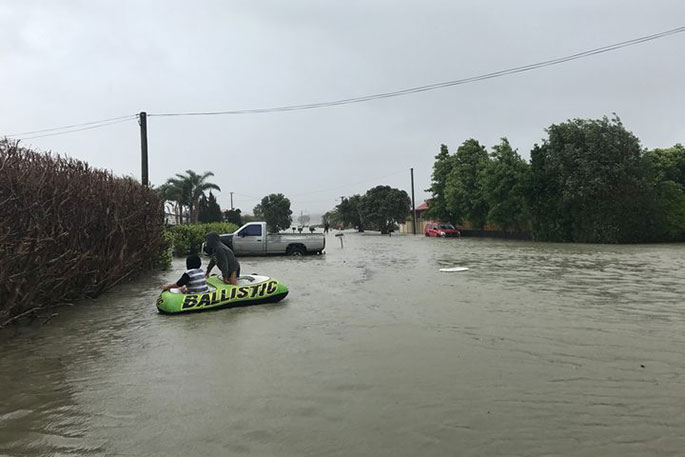
Kaiaua resident Alex Corbett never believed in climate change - but a large storm that hit the Firth of Thames in January, flooding his home and dozens of others, was an eye-opener for him.
"I've been a total non-believer up until the fact."
He says he saw Al Gore's documentary last year which began to open his eyes but after seeing the tide take over his town, he was now a firm believer.
The storm that flooded Mr Corbett's home was the first major one of 2018 - since then several cyclones have battered the country during a record-breaking summer.
Niwa figures show the average temperature nation-wide during the summer months was 18.8°C, which is 0.3° above the previous record set in 1934-35.
The seas around New Zealand saw temperatures that were 6° above average, while a high of 38.7° in Alexandra on January 30 was the country's hottest January temperature in 39 years.
It wasn't just warm weather affecting the country though - cyclones and flooding prompted 10 civil defence state of emergencies to be declared in the past three months.
That's compared to 13 throughout all of last year.
The Insurance Council estimates extreme weather has caused $65 million worth of damage - Cyclone Fehi alone cost $39m and the costs from Cyclone Gita have yet to be tallied.
Alex says having seen the extreme weather that was being caused by climate change, he was worried about other coastal communities in New Zealand.
"I think the vast majority of the population are like me - you hear the stories from the ... greenies, saying 'global warming, global warming' and I think we are behind the eight ball now."
Climate Change Minister James Shaw says New Zealand was experiencing the effects of a warming planet and the past summer had created much more discussion around the issue.
"It's become a topic of conversation in a way that it really wasn't before, and it's not just because people are looking at the data, but because people's felt experience is so different.
"We're having this extraordinary summer, multiple cyclones, flooding and people are starting to join the dots and going 'that thing we've been talking about for some time, climate change, this is what it feels like'," he says.
James says people now accepted climate change was being caused by humans and that more action was needed to stop it.
"We also need to have more of a conversation about how we adapt to the effects of climate change, now that we are definitely starting to feel them.
"That's not something that we've had a whole lot of work done in New Zealand on and it's something that I hope this year we make some progress on."
Niwa meteorologist Chris Brandolino says what had started as a dry summer, with droughts declared in parts of the lower North Island and areas of the south, turned very wet.
"When you look at rainfall totals for the summer season, a lot of places experienced rainfall that probably wasn't too far from normal but when you drill down and look at how that rainfall was distributed, it was anything but normal.
"It wasn't distributed evenly."
The warm weather isn't over yet - Chris says Niwa was forecasting higher than average temperatures for the three months to June with a higher risk of heavy rainfall events for the northern and eastern parts of the North Island.

3 comments
Climate change - not necessarily global warming?
Posted on 04-04-2018 13:36 | By MISS ADVENTURE
Climate change has always been an issue, it always changes and always will. The consequence of that is what we firsly should be concerned about then have a good think about why?
Climate change
Posted on 04-04-2018 13:43 | By MISS ADVENTURE
Is a natural thing but humans are adding heaps to it so extending the effects a lot. the consequences include: more/heavier rain, more violent storm events, more of them more often. Sea level increases, movement of the plant and animal habitation zones. Hotter many places, colder others, wetter some, drier others. Changes in weather patterns, cropping areas and so on will all result from the above. Many plants/animals will be affected some good, many badly. The entire paradime of mother nature is changing as a result, it is adjusting and resetting itself based around teh inputs to the enviroment... obviously. Although this may have historic comparison, the fact remains that the worst past examples are massive and in fact rate as the largest mass extinctions in earths history. Reality is: mother nature will survive, humans wont.
Dear James.. (Shaw)
Posted on 04-04-2018 16:19 | By groutby
"James says people now accepted climate change was being caused by humans" .....WRONG !!.. the Science is far from 'settled' my friend...please do not make up my mind for me...I am quite capable of doing that myself !
Leave a Comment
You must be logged in to make a comment.