


Fingal's Cave is a sea cave on the uninhabited island of Staffa off the west coast of Scotland in Argyll and Bute.
It's often described as one of the natural wonders of Scotland.
'Felix Mendelssohn was barely 20 years old when he set off to visit the Scottish Isles in 1829,” says Opus Orchestra conductor Peter Walls, at Sunday's concert in Baycourt.
It's always interesting listening to Peter as he launches into one of his highly enjoyable and much-too-brief monologues prior to conducting the orchestra members through more than an hour of music.
'Mendelssohn was hugely impressed by what he saw. He wasn't initially too happy with this first draft of his overture and wrote back to his sister Fanny that the development smelt too much of counterpoint and not enough of train oil, gulls and salted cod.”
Peter's words followed by the orchestra's playing of Fingal's Cave conjures up the austere grandeur and isolation of Staffa and the rush and ebb of the Atlantic Ocean.
I had followed Mendelssohn's footsteps in Harlam near Amsterdam and was always struck by the complete joy, wonder and lightness in his music. I could visualise him while Peter was talking, on board the boat, sketching out some musical ideas.
'So the first thing we need to know about his trip out to where Fingal's Cave is, is that he got violently ill along the way and you can sense in this piece quite a lot of turbulence.”
Although Mendelssohn to his sister Fanny, and now Peter to his audience, were being facetious, they both try to do something quite original.
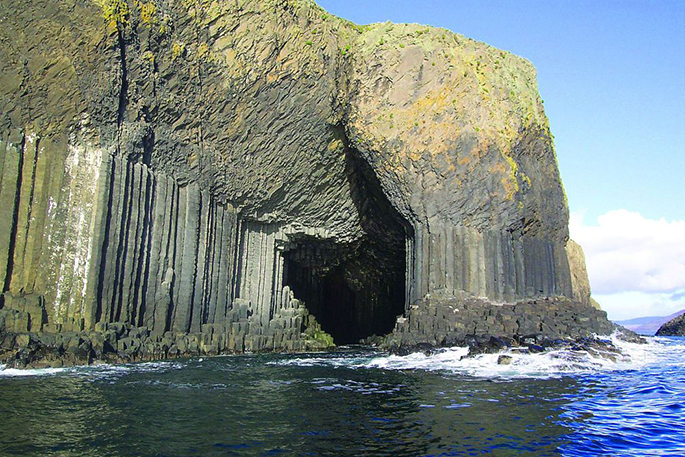
Mendelssohn visited Fingal's Cave in 1829 while on a tour of Scotland. The structure is formed from hexagonally jointed basalt columns. Photo: supplied.
Fingal's Cave, skilfully and fluently played by the Opus Orchestra conjures up the misty seascape, a sense of the grandeur of nature and the natural phenomenon of the cave. As Peter suggested, at one point you feel like you're out in the fog with one boat calling to another.
Felix Mendelssohn completed his Hebrides Overture on December 16 in 1830.
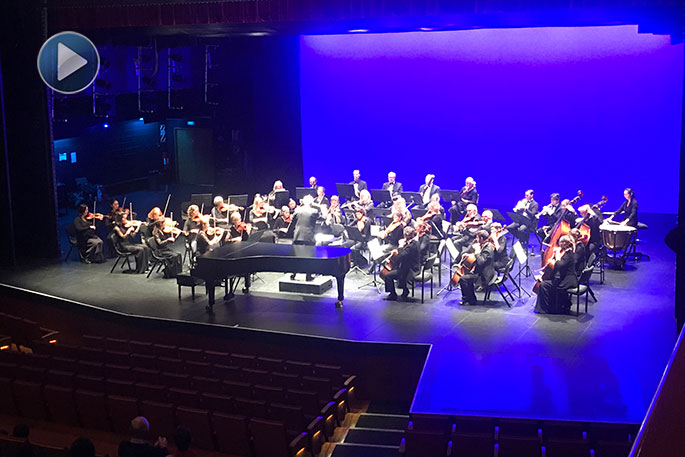
Next on the programme of music composed by the three friends Mendelssohn, Schumann and Brahms was Robert Schumann's Concerto in A Minor for Piano and Orchestra.
Robert's sister Clara played it for the first time in 1845 and for the Tauranga performance we had one of NZ's most distinguished musicians and concert pianists Dierdre Irons at the grand piano. She made her debut at age 12 playing Schumann's Piano Concerto with the Winnipeg Symphony Orchestra in Canada. A prodigy then and seriously impressive now.
Often concertos are written to show off the technical brilliance of the pianist, with the orchestra deferring to the piano but Schumann resisted that and although having solo sections, the piano enjoys an often intimate and lyrical dialogue with the orchestra.
In the second half of the programme, we indulged in Johannes Brahms Serenade No. 1, Op. 11.
"I'll never write a symphony!" Brahms once groaned. "You have no idea how the likes of me feels with the tramp of a giant like him behind you!" By "him" Brahms meant Beethoven. Once again Peter Walls took us through a fascinating snapshot of a composer's life.
His first serenade is an enormous work. As Peter pointed out, it's interesting about that giant walking behind him because when you get to the last part, you can hear a moment of total stillness and then you hear the beginning notes from ‘Ode to Joy'.
Opus is our professional regional orchestra led by concertmaster and violinist Elena Abramova and directed by Peter Walls and performs regularly in Tauranga, Hamilton and Rotorua.

1 comment
Thank you
Posted on 06-07-2017 08:55 | By overit
Sunlive, we went to this concert as we won tickets. It was fabulous, especially Dierdre Irons.
Leave a Comment
You must be logged in to make a comment.