


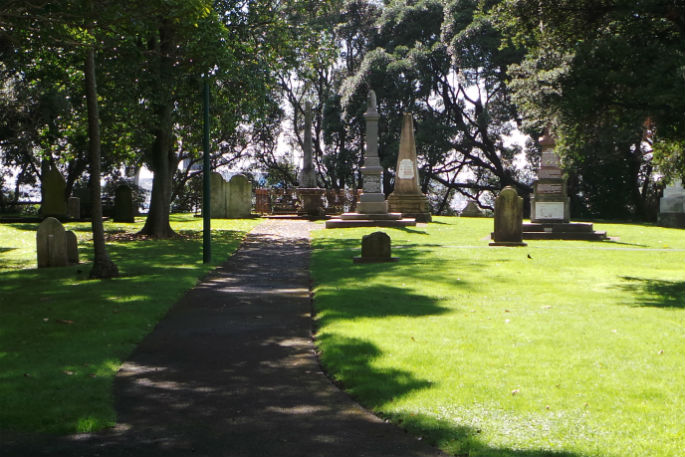
Tauranga's Mission Cemetery provides a closer link to NZ Archaeology Week and NZ Cemeteries Week than many people may think, says Heritage New Zealand's Lower Northern area manager, Ben Pick.
Both are running in the opening week of April and the two themes have strong Tauranga connections.
'People looking for green space, some fascinating history and a pleasant walk will enjoy exploring a historic burial ground like Tauranga's Mission Cemetery,” says Ben.
'As well as providing an oasis of calm away from the bustle of everyday life, the cemetery also enables people to reconnect with our shared history through a fascinating lens.”
The cemetery offers a particularly good view into the city's past.
'Before the cemetery was established, the site was originally Otamataha, the Ngai Te Rangi Pa. The pa was abandoned in 1828, however, after most of its inhabitants were killed by Ngati Maru raiders from the Thames district.”
Church Missionary Society missionaries first visited the pa briefly in the 1820s, and returned in 1835 when the land was still uninhabited after the 1828 attack.
The missionaries were looking for land on which to establish a mission station, and the pa site seemed a logical choice.
'Rev Alfred Brown established Te Papa Mission Station – known also as The Elms – and the nearby pa site became a burial ground; the oldest European burial ground in Tauranga,” says Ben.
The earliest burials in the cemetery reflected the central part the Mission played in early Tauranga life. Burials included Ann Wilson, wife of missionary John Alexander Wilson; Marsh Brown, the son of Alfred and Charlotte Brown; and Irihapeti, the wife of trader John Faulkner.
Events in 1864 were to have a major impact on Tauranga – and would even impact on its cemetery.
'The graveyard became a burial ground for about 100 imperial and colonial troops as well as 14 Maori warriors who died while on active service in the Tauranga district during the New Zealand Wars,” says Ben.
'Some of the graves include those who fell during the battles at Pukehinahina (Gate Pa) and Te Ranga in 1864, and – in later years – casualties of other skirmishes at Te Irirangi and Whakamarama. In time it also became known as the Old Military Cemetery, reflecting its role as a military burial ground.”
Other graves include soldiers who died from dysentery and typhoid at Camp Te Papa between 1864 and 1876.
'Besides military personnel, the cemetery is the final resting place for many of Tauranga's earliest settler families, and is one of the oldest public amenities in Tauranga,” he says.
'It is also an archaeological site in its own right, spanning centuries of different use. Along with some of Tauranga's other stand-out heritage sites – including Mauao and Monmouth Redoubt – the Tauranga Cemetery is of great significance, and well worth exploring.”
New Zealand Archaeology Week runs from April 1-8.
Fallen soldiers
The story of Captain John Fane Charles Hamilton, who lies in Tauranga Mission Cemetery, is representative of the courage of many of the combatants – both Maori and Pakeha – who lost their lives during the battle of Gate Pa, and other battles of the New Zealand Wars.
Hamilton's headstone is fairly succinct: ‘In memory of John Fane Charles Hamilton Captain of Her Majesty's ship Esk who fell in the assault on the Pukehinahina Pa Tauranga on the 29th of April 1864 aged 43 years.'
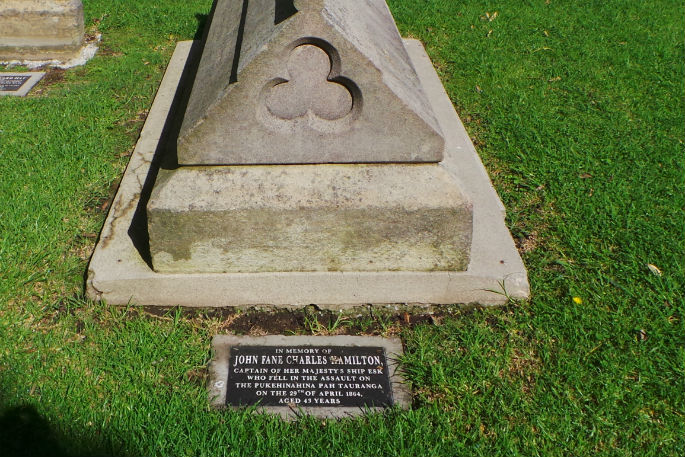 Captain John Fane Charles Hamilton's grave.
The Southern Cross newspaper of May 3 1864, however, went into more detail:
'The General, who was in the advanced trench of his position, ordered up the supports almost immediately after the storming party rushed the breach; and the second division of blue-jackets and the gallant 43rd, led by Captain Hamilton, of the ‘Esk', advanced with a ringing cheer to the support of the forlorn hope.
"They arrived at a critical moment, the storming party exposed to a murderous fire on all sides, and from hidden assailants beneath, and without an officer left to lead them, were wavering; part were outside the pa. Captain Hamilton sprung upon the parapet, and shouting ‘follow me men!' dashed into the fight.
"That moment was his last. He fell dead, pierced through the brain by a bullet, and many of his officers shared the same fate.”
On April 28 1864 – the night before the battle of Gate Pa – many of the British officers were invited to dine at the Elms Mission Station.
'Those who weren't already in their field positions attended, though every one of them – with the exception of the Surgeon General William Manley – was killed during the battle the following day,” says Ben.
'Many of these officers are also buried in the cemetery.”

0 comments
Leave a Comment
You must be logged in to make a comment.