


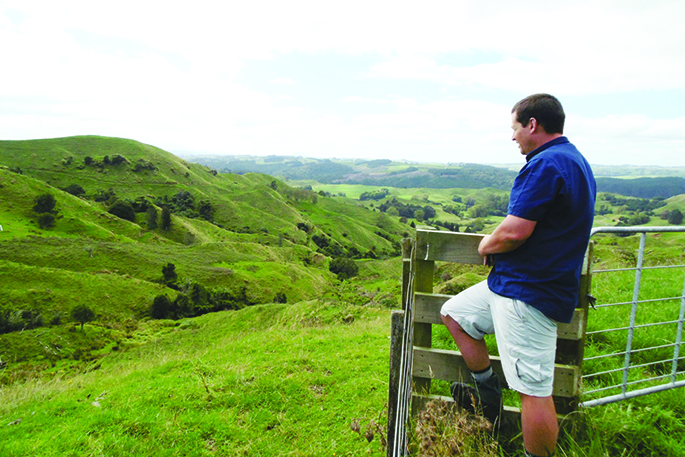
King Country farmers Reon and Wendy Verry fear Waikato Regional Council's Plan Change 1 could make their farming business uneconomic, impacting on staff and others involved with the 1300 hectares farm.
Submissions closed in March on the Waikato Regional Council's Healthy Rivers/Wai Ora Proposed Waikato Regional Plan Change 1, which the council has instigated to address the problem of water quality in its region.
It wants to set policies and rules to bring about a reduction in sediment, bacteria and nutrients –nitrogen and phosphorus – entering water bodies, including groundwater, in the Waikato and Waipa river catchments, which is an area of 1.1 million hectares.
This proposed plan change for the next 10 years is the first step towards meeting the vision and strategy for the Waikato River during the next 80 years.
In plain-speaking terms the proposal wants all farms larger than 2ha in the Waipa/Waikato area to fence all ‘permanent' water to prevent stock from entering these waters. This also means water reticulation for paddocks would need to be installed as well.
Reon and Wendy run a sheep and beef farm on the southern outskirts of Te Kuiti, which has been in Wendy's family for 30 years.
Helping farmers
Reon has investigated the regional council proposal, encouraged other farmers who will be affected to get involved and even held submission workshop meetings in the wider area to help farmers to get their heads around the proposed changes.
The result was the formation of King Country River Care. Reon says everyone in the group simply wants to run a sustainable business from every point of view – environmentally, financially and socially. 'That's my real problem with this plan,” says Reon. 'It looks at the environment but it's ignoring the economic and social costs, which will come about if it is implemented as it is proposed.”
Reon says every farm faces a different set of challenges. 'Farmers who have to put in place expensive reticulated water before they can fence off water will struggle to meet the timing requirements of PC1.”
The submission workshops drew 300 farmers but Reon is unsure how many put submissions in. He says the process was tough, submissions had to be detailed and precise; he encouraged farmers to keep it simple but to get something in.
Reon found the plan to be full of inconsistencies and contradictions. It was hard to cope with, hard to get a true understanding of what was wanted.
Different story
'You read one part and then the next section tells a different story.”
He believes once council got the draft plan they should have looked to see if it would or could work.
'But they chucked it out to the public to see what the reaction would be. The implementation team should have had more time to establish if things could really be done.
'They have made it too hard. Farmers are anxious, worried about what will happen; the rules are so different to what we have ever faced before.”
WRC is reacting to government legislation on the management of fresh water and Te Ture Whaimana o Te Awa o Waikato – The Vision and Strategy for the Waikato and Waipa rivers – which was adopted by the Government as part of the Treaty of Waitangi settlement legislation.
There are 12 main points in the Treaty settlement and WRC chose two; swim-ability and fish-ability.
Reon says even when you read the Draft Plan you cannot be sure what you need to do. 'The document contradicts itself. One part says ‘all water bodies must be fenced to exclude cattle, horse, deer and pigs' but not sheep; another grey area. Any flowing water, any drain, any stream or swamp has to be fenced.”
Alternative mitigation
And then in another section it says everyone has to have a farm environment plan and if the land is over 25 degrees it does not have to be fenced but alternative mitigation can be applied.
'It is just confusing. I don't know which one I have to go by. These two provisions should have been looked at more closely before they went out to the public. And they should have consulted with farmers as what was practical and do-able before calling for submissions.
'For our farm we have to have it complied by 2023 – that's six years to fence all water at a conservative cost of $100,000. Our neighbour across the road has to put water in as well as fencing off the natural water – at a cost of about $840,000.
'When you fence off natural water you have to ensure all paddocks have reticulated water. One of the lucky things in this area is the natural water,” says Reon. He agrees with fencing stock out or away from waterways, but is not supportive of the council's definition of waterways.
The water from Reon and Wendy's farm goes into the Mangaokewa Stream, which eventually feeds into the Waipa at Otorohanga. The water is tested at Te Kuiti and it presently shows acceptable levels of nitrogen – at the 80-year acceptable level – but high levels of ecoli.
Between the farm and Te Kuiti there are two meat works and a timber processing plant, sale yards and of course the natural run-off from the township. Farmers would like to see more water testing sites.
More testing sites
The water is not tested at the farm gate but it is only the farm that is being required to change its environment. 'Perhaps with more water testing they could find the source of any contamination and deal with it at the source instead of this blanket set of rules to change farming practices.
'I will fence anything if it is really going to make any changes but to spend hundreds of dollars on a ‘might fix the problem' is hard to swallow,” says Reon.
He says it should be about subcatchments, not a blanket approach. Grand-parenting of nitrogen use rewards polluters and it needs to be removed from the plan change, believes Reon.
'The nitrogen rule is just death by a thousand cuts and the fencing rule is like a sledge hammer to the back of your head. We just need to know what the problem is and fix it.”
The other grey cloud looming is that this plan is only in place for 10 years.
'If we fully comply – fence everything and then in 10 years, when the water is still not meeting its targets, regional council may try to force us to change from being a sheep and beef farm to growing trees. This would completely finish our business, our lifestyle and those who work for us and with us.
Greenhouse gas commitments
'Is this what they really want – to plant pine trees to replace those taken out for dairy conversions? Is this their way of complying with the greenhouse gas commitments?,” asks Reon.
'Everyone is pointing at everyone else and at this stage there is not enough science to fix it. We don't want animals in our waterways and we have already minimised the damage. It is common sense but council has suddenly taken things to the extreme while ignoring how it will affect farmers and farming communities.”

2 comments
I sympathize.
Posted on 03-04-2017 12:49 | By morepork
It sounds like more thought and clarification is definitely needed. BUT, it needs to be done! Our waterways are a disgrace and it needs to be fixed. Government should be applying itself to making sure the questions are answered and the implementation strategy is viable and clear, not just in the Waikato but right across the nation. If farmers need help (financial and practical) to get it done, then they should be given that help. it isn't about punishing the farming community, it is about getting it sorted.
nz
Posted on 04-04-2017 05:50 | By Capt_Kaveman
is over farmed and the avg nzer gets no benefit and in return we get filthy waterways, dairy needs to be reduced and farm other animals and or grow more agriculture
Leave a Comment
You must be logged in to make a comment.