


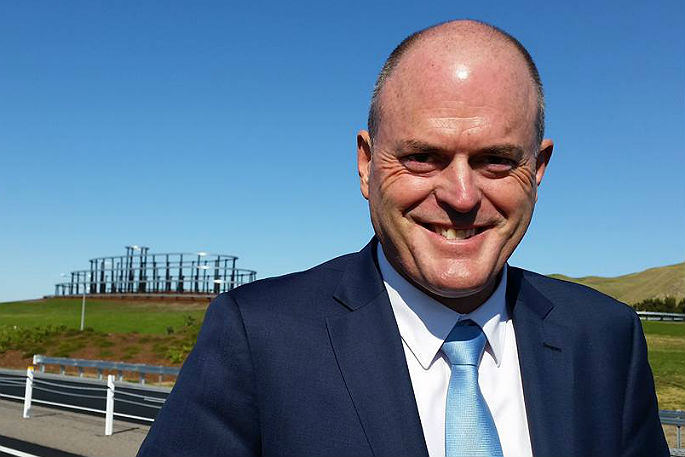
Bay of Plenty MP Todd Muller is encouraged by Civil Defence Minister Gerry Brownlee's announcement today that the implementation of a new nationwide channel for sending alerts about emergencies, such as tsunami warnings, to mobile phones is on track to be up and running by the end of the year.
Cell broadcast alerting is a new way of sending information to mobile phones in a set area without people needing to subscribe to a service or download an app.
The alerts appear in a similar fashion to a text message and are received automatically and for free by all cell broadcast enabled mobile phones in the area.
Todd says the announcement is great for a community like the Bay of Plenty, where we have been let down by alerting systems in the recent past.
'This system will communicate the risk faster and more reliably than ever before, and is not vulnerable to network overloading meaning alerts can still be sent if networks get busy after a natural disaster.
'This is a welcome improvement, but no technology is 100 per cent failsafe, which is why we will continue to use and explore multiple channels to keep our community safe such as radio, television, social media and sirens.”
This plan has involved a number of companies such as 2degrees, Vodafone, Spark who are working together to enable this technology for the first time in NZ.
There has also been significant involvement from the Ministries of Civil Defence, Health, Primary Industries, and the New Zealand Fire Service.
'It's great to see so many Kiwis come together in collaboration to implement a system to keep at-risk communities safe,” says Todd.
'Tauranga City Council is also doing some great work with updated tsunami evacuation maps being delivered to all households in the Mount and Papamoa this month, improved evacuation route signage, and the construction of the southern hemisphere's first vertical evacuation structure.
'When viewed as a whole, our community can rest assured knowing that their concerns have been heard loud and clear, and that both central and local government are working to deliver solutions that work for our residents.”

3 comments
Yet another...
Posted on 07-03-2017 21:30 | By penguin
...shallow photo opportunity (just like the other local national guy) while appearing to say something important. Many of his statements simply echo the obvious and amount to little more than political rhetoric.
she 'll be right mate....
Posted on 08-03-2017 09:27 | By Real
Has no one done their homework. In a major disaster most communication networks will be down, land lines cell towers, internet connections are to fragile to use as a reliable Waring mechanisms. Not sure who makes these decisions but get your head out of the dark place it's stuck.
@Real
Posted on 08-03-2017 10:21 | By cbj
You're quite right, sort of. In the event of a strong earthquake or similar disaster where there is no way of knowing that it is going to happen until it already has, there is the potential for these systems to fail, but they don't always. On the flip side, this will be a great improvement to the current early warning system that is in place which uses SMS which is slow and time consuming compared to Mobile Broadcasting as SMS often requires messages to be sent one at a time. Mobile Broadcasting on the other hand works a bit differently as it allows you to broadcast to all phones within range and they all get the message at roughly the same time. For the likes of tsunami warning it is a much better system.
Leave a Comment
You must be logged in to make a comment.