


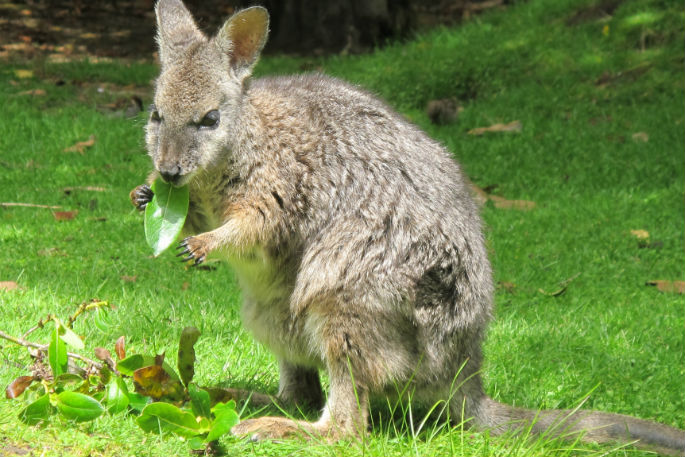
The Bay of Plenty Regional Council wants to hear about any recent sightings of wallabies in Welcome Bay to see if an eradication programme is working.
The wallaby population between Rocky Cutting and Reid Road in rural Welcome Bay is believed to have been there for some time, says biosecurity manager Greg Corbett.
They first became aware of the isolated population seven or eight years ago.
'We have no evidence to suggest this but we have heard enough rumours to think where there's smoke there's fire type of thing - that there was a guy used to live up here who was involved in the live export business, and it's quite possible some of the animals he was holding there may have escaped.”
Twenty years ago Dama Wallabies were exported to zoos and as exotic pets.
'That died a natural death probably with more stringent animal welfare and export certification issues,” says Greg.
The regional council had no tools or methods to be able to detect or find wallabies, particularly in low numbers.
They have trained up a couple of indicating dogs and have adopted the use of trail cameras, motion sensitive cameras that hunters use to see where deer are walking about in the bush.
Then the council had to develop a control methodology, and worked with the manufacturer adapting Feratox cyanide pellets for use on wallabies.
The pellets had to be tested and registered for use on wallabies, a process that took about a year.
Two years ago the first control operation took place which resulted in about 30 dead wallabies being found near the bait stations.
Monitoring since showed a handful of survivors, which they have done a little bit more work one, and now they are about to go back and see if there are any survivors.
As far as they know the Welcome Bay wallabies have always been separate from the core Dama Wallaby area east of Rotorua.
But it's important reports of sightings are made on the day so council staff can act before the trail goes cold.
'In the last year or two we are getting better at finding and controlling the small populations we are finding outside the core population,” says Greg.
'But that's not saying we don't have a big challenge in front of us.”
At the moment tackling the core population is beyond their resources, and they are focusing on keeping them contained.
Feratox is useful, night shooting on some farmland situations also useful. The only other control is 1080, and there are community concerns about the widespread use of 1080.
The challenges include not having the tools to do the job at the moment, having to then research to get new tools, go through the legal requirements to be able to formally use them - and doing all that research necessary but when there is only so much money available.
'We have to balance how much we invest in research with how much we spend trying to contain the problem that we have now, and not let it get worse,” says Greg.
'It might take 10-15 years to get all the tools we want if we had all the money in the world available, but by that stage we might have lost the game because they have expanded their range too much.
'As far as we know that (Welcome Bay) population is quite a contained population but as I say our tools are fairly limited and that's why reports from the public about sightings are really important for us.”
Dama wallabies are one of the smallest wallaby species, standing up to half a metre tall. Adult females weigh around 5 kilograms, while males can weigh up to 7 kilograms. They are grey-brown in colour with a paler grey underbelly. A thin white-silver stripe runs from under the eye to the nose. Mature animals may have a patch of reddish brown colouring at the shoulder.
Wallaby were first introduced to New Zealand around 1870 by Sir George Grey, when they were released onto Kawau Island. Dama wallaby, sourced from Kawau Island, were subsequently liberated near Lake Okareka in 1912.
They have since spread west to Rotorua, east to Kawerau and south to about Rainbow Mountain; an area of approximately 200,000 ha.

0 comments
Leave a Comment
You must be logged in to make a comment.