


'The odds are better than Lotto that we're going to cop a tsunami at some stage. And it's not going to be nice.”
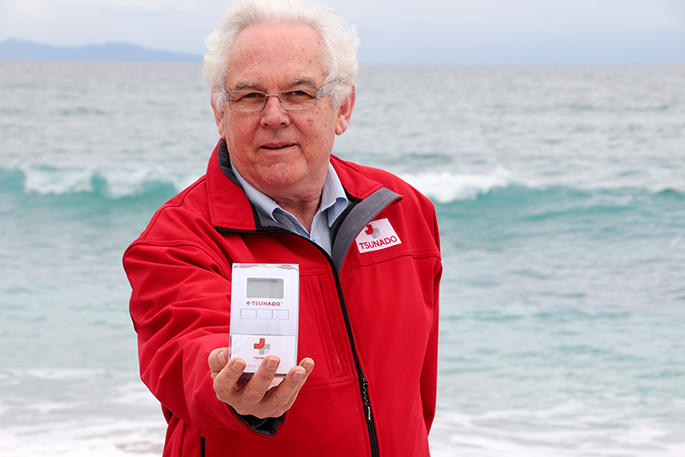
Prophet of doom, scaremongerer? Neither, says Gary Benner, who is developer of the tsunami alert system called Tsunado.
'During normal times it's just a radio,” says Gary. 'But in the event of a disaster situation like a tsunami, it will let you know in no uncertain terms.”
Gary says he's a realist with a genuine desire to save lives.
The Bay of Plenty Civil Defence Management Group has the same genuine desire. But the group and Gary are at odds over how best that can be done.
The Ministry of Civil defence and Emergency Management is exploring a national public alerting system using mobile phone technology.
'We support a national system in addition to our current local and regional text alert and email update system,” says Emergency Management Bay of Plenty group controller Clinton Naude.
'Therefore, at this stage we are not pursuing the Tsunado alert system.”
Gary says cellphones can't be relied on to be alerting devices. But his Tsunado can be relied on.
'And I would be extremely disappointed with my life if I woke up one morning to find my family in Papamoa had been washed away by a tsunami of the Aceh scale because we weren't prepared.”
He refers to the 2004 tsunami that killed 230,000 people and injured half a million when 30 metre waves swept ashore through Asia.
And Gary says what happened at 4.37am, Friday, September 2, this year here in the Bay of Plenty should be warning enough. 'In my view that was a near miss.”
A quake – 7.1 on the Richter scale, north-east of Te Araroa – rattled a sleeping Bay of Plenty. It was the worst quake to hit the North Island for 20 years, but we slept on through. A 30cm tsunami warning fizzled, but Gary says we should learn from that.
'If the volatile Kermadec Trench, the wave generator, had triggered a slightly different earthquake it could have thrown up a tsunami of Aceh proportions,” says Gary.
Travelling at 600 km/h, it could dump on Papamoa and Mount Maunganui within 50 minutes. 'What would we do, how would we react if that happened in the dead of night?”
A report commissioned for the Bay of Plenty Regional Council suggested the worst-case scenario could kill up to 900 people and cause $54 million worth of damage.
The 2004 event caused Gary and his colleagues to spend 12 years and hundreds of thousands of dollars researching the technologies, trialling prototypes and pursuing funding.
Their answer was the Tsunado Alert Radio, which uses broadcast radio. 'The most rugged and reliable method of communication proven over decades,” says Gary. And he says when used with Freeview and Sky satellites, there's blanket coverage for the entire country.
But Gary claims to have run into 'an immovable wall of indifference and inertia” with the Tsunado system. He claims in 2014 it got unanimous support from regional civil defence organisations. 'But since then nothing.”
'To clarify,” says Clinton. 'We haven't changed our minds, we only ever trialled this technology.”
But Civil Defence is thinking differently to Gary – it's looking at alert systems based on cellphones.
"There is a difference between alerting and information,” says Gary. 'Cellphones aren't alert devices because they can be switched on to silent at night or switched completely off.
'And nature doesn't always bring on its wrath during the day.” And who, he wonders, would respond to a text message in the middle of the night?”
Gary says mobile phone technology is fragile. 'In a real-life disaster scenario, it's almost always been found cellphones fail quickly and become an ineffective means of communication. And the cell towers that send these messages often go down.”
The Emergency Management Group says all forms of technology are risky to one degree or another. And that's why it's important people understand natural warning signs for a local source tsunami, 'like an earthquake that lasts more than a minute and is strong enough to knock you off your feet.”
Head inland or to higher ground. And it recommends having a battery-powered radio in your survival kit.
Exactly, says Gary. When all else is failing in a disaster situation, broadcast radio and satellite systems don't have the same vulnerabilities. They keep on transmitting.
'Once activated the Tsunado's radio speaker can be automatically turned on to a broadcast radio message or a text message displayed on-screen.” Gary says people need to be alerted and they need good, clear information to act on. 'People will respond quickly only if they trust what they are hearing, particularly in the middle of the night.”
Tsunado alert radios have a managed power system so when running on battery they only turn on to receive alert messages. That allows them to last 5-10 days without recharging.
'Emergency services had previously tried to communicate using sirens, but even if people hear them, they don't communicate the necessary information of what to do,” says Gary.
The Callaghan Institute bankrolls technology and product research and development; and in 2013, in a vote of faith, gave Gary $255,000 matching finance to complete the Tsunado system.
'It helped develop a central warning activation system we call Tsunado Central. This manages the whole alerting process, and allows emergency managers from all regions to set up and configure alert profiles.
'This includes who needs to know, what is to be said, and where the messages need to go.”
Gary says his company has done everything to say ‘this is a good way to help save lives'. 'But if something happens and people die, that's the worse thing for me – that a difference could have been made, and no one took it up.”

7 comments
Cell Phone Useless.
Posted on 14-11-2016 17:57 | By tabatha
As I have mentioned else where a cell phone is useless to warn people as it does not give an alarm for Tsunami warning. The sound is the same for any message. To those planners get off the grass and start acting fast. Before we know it problems will arise. Congratulations to the Coromandel with the sirens at Whangamata. I wonder if relatives could sue the people concerned re inaction over adequate warnings.
50 minutes?
Posted on 14-11-2016 21:50 | By waiknot
So within 50 minutes the scale of the potential tsunami neess to be assessed, than notified to the public and all of the coastal strip evacuated to higher ground. Your joking right? I'd rather sleep through it and never no than fight a loosing flight.
Get a siren
Posted on 14-11-2016 22:01 | By Bay Citizen
I agree with tabatha. Mobile technology WILL NOT WORK. The beep from a text message arriving will not wake anyone. In any case, I keep my phone off during the night on principle. I do not wish to be contactable then, but would appreciate a siren to warn of mortal danger.
Council egos are holding up sirens....
Posted on 15-11-2016 09:32 | By jed
Tauranga council wrongly determined electronic sirens were the best tsunami warning option-they were too quiet. This ridiculous decision was made clear when the public tested air raid type sirens from Tactical tooling which outperformed the electronic sirens. But council egos were miffed and they used the RMA to reject air raid sirens, while quietly scrapped the electronic sirens. So we end up in todays situation, tauranga council are rejecting a good warning system and now playing deaf dumb and blind. The council is incompetent and risking community lives. A life threatening tsunami is a question of when, not if. Check historical records.
Jed
Posted on 15-11-2016 11:32 | By Kenworthlogger
If you are that worried about a tsunami then dont live at the beach and whine about it right?
Laughable
Posted on 15-11-2016 16:07 | By Riddick
I got 2 Tsunami warning texts at 3:25 in the morning followed immediately by a tsunami downgrade text, all three came through at the same time, 3 hours after the earthquakes. Definitely need sirens on the immediate beach, most at the Mount could make Mt Drury or the Mount itself in minutes if we all walked ran or biked. Sadly most would jump in cars, cause traffic jams and die. People are dumb.
Jmac
Posted on 15-11-2016 17:17 | By JohnMac
Should we be concerned really, When was the last tsunami on the east coast that actually was a threat.
Leave a Comment
You must be logged in to make a comment.