


Authors of the new draft plan for management of the northern snapper fishery are going to be at a public meeting in Tauranga on Thursday.
The meeting at the Tauranga Yacht and Power Boat Club from 5-7.30pm will enable local fishers to talk over how the Ministry of Primary Industries proposes to double the amount of available fish without lowering the allowable catch.
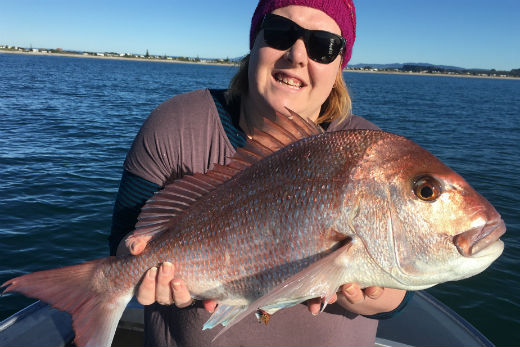
The snapper or tamure (Pagrus auratus) caught here by Janene Burns, is the major inshore finfish species of northern New Zealand, important to all fishing sectors; a ‘taonga' for Māori, an important food source caught and marketed by commercial fishers, and a highly prized catch for recreational fishers.
The draft plan proposes doubling the snapper population for the SNA1 fishery to 40 per cent of the unfished biomass in 25 years, without reducing the total allowable catch in the current financial year.
It means rebuilding the fishery to a state where it contains 40 per cent of the amount of fish that would have been there in the absence of all types of fishing.
The plan specifies an intermediate target of 30 per cent of the unfished biomass by 2025.
The Ministry of Primary Industries intends to achieve this by reducing waste and improve productivity, improve monitoring and management of the SNA1 fishery, improve reporting and understanding of the snapper habitat and environment.
The snapper one quota management area won't be sub-divided at this time, but the Ministry plan calls for the three sub-populations of East Northland, Hauraki Gulf, and Bay of Plenty to eventually be monitored and assessed separately.
The draft snapper management plan is available online.
The plan is presented by the SNA1 group assembled under the Aegis of Fisheries Minister Nathan Guy to sort out the issues with the North Island's major fishery.
Stakeholders are in the best position to provide more detailed guidance on snapper matters and the future direction of the fishery, says Nathan.
'It will be no easy task, stakeholders will need to move beyond vested interests and finger pointing and work constructively together. I intend to review the fishery again in five to seven years.”
Current snapper numbers will be assessed in a tagging survey expected to begin later this year. Regular monitoring of the stock is proposed to ensure it is on track to reach target and timeframe.
Education and gear modification is also proposed for commercial and recreational fishers to reduce the catch of juvenile fish.
Over time, the minimum landing size will be aligned for commercial and recreational fishers. Increasing the MLS only becomes an option when selectivity has been measured and survivorship of released fish is reliably estimated.
Recreational charter fishers will be required to report snapper catches. Māori customary non-commercial catch reporting estimates are to be improved including through the Crown assisting iwi to use electronic reporting.
Snapper habitats of particular significance for snapper are to be identified, mapped, areas under threat identified, as well as the loss of habitat be estimated, in 2017.
Previous catch limits were based on deterministic estimates (best guess based on known data) of the biomass sustainable yield which resulted in biomass targets of 21 per cent to 23 per cent of the unfished biomass.
It's now considered more appropriate to set a biomass target by taking into account natural variability, harvest strategies, and other factors that influence a fishery. The default biomass target for snapper based on the biological characteristics of the species, is now considered to be 40 per cent of the unfished biomass. This biomass target reflects international best practice.
The most recent stock assessment estimated the overall SNA1 stock biomass in 2013 to have been at approximately 20 per cent of the unfished biomass, combining the results for the separate sub-stocks. The separate sub-stocks were assessed as being at 24 per cent of the unfished biomass for the East Northland sub-stock and 19 per cent for the combined Hauraki Gulf/Bay of Plenty sub-stock.
These values are median estimates. Although the biomass has increased by as much as 70 per cent in some parts of the stock since 1988, it appears to have levelled off since about 2005.
For a stock such as SNA1 that is currently estimated as being below the recommended target, the Minister must consider how quickly the biomass should be increased to reach the target. Reductions to the current TAC and catch would be likely to increase biomass at a faster rate, but would have impacts on fishing.
Making no changes to the current TAC and current fishing practices will result in a slower rate of biomass increase with the possibility that there would not be a significant increase in biomass above the current level.
Fishing reduces the biomass and the number of slow-growing older fish, and shifts the population structure towards faster-growing younger fish. This results in a surplus production that can be harvested sustainably. Fishing can be sustainable at different levels of biomass, but long-term yield is maximised at a specific biomass level that is determined by a stock's biology. A stock's biomass is also influenced by factors unrelated to fishing, including environmental variables such as water temperature, food availability, and changes in water and habitat quality.

2 comments
lets be fair
Posted on 09-09-2016 15:34 | By hapukafin
Snapper stock wont rebuild if the commercial sector is taking 25cm fish.Commercial and recreational size should be the same.All receational fishers should vote for the party that is going to introduce the same size rule.
Its a have
Posted on 09-09-2016 18:33 | By overit
Good old MPI. Commercial fisherman should be using special nets that let the little fish go.
Leave a Comment
You must be logged in to make a comment.