


The lack of tuna in the Bay of Plenty, something sport fishers have been grumbling about for years, has finally hit the national stage.
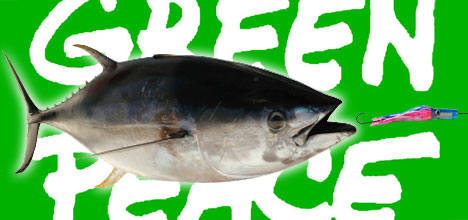
The impact of commercial purse seiners on the fishery is being blamed and the New Zealand Sport Fishing Council is joining forces with Greenpeace to use consumer pressure to force fishing companies to change their methods.
Fish aggregation devices are being used to lure fish to an area the purse seiners then cast their nets about.
They caught more than three million tonnes of tuna last year, and a bycatch that includes sharks, turtles, mahimahi and marlin.
The high bycatch rate is unsustainable and avoidable, says NZ Sport Fishing Council president Richard Baker.
Also ensnared by these huge nets are juvenile yellowfin and bigeye tuna, species that have already declined in New Zealand waters.
The Western and Central Pacific Fisheries Commission (WCPFC), which New Zealand is party to, has failed to limit expansion in this fishery. The New Zealand Sport Fishing Council has joined forces with Greenpeace to bring consumer pressure on the fishing companies to change fishing practices considered unsustainable.
'The impact of this bycatch is felt not just in the tropical Pacific, but throughout the range of these highly migratory species – including New Zealand waters,” says Richard.
'As recreational fishers we're often the first to be affected when stocks start to decline.
'We have been sounding the alarm on yellowfin for a few years now – but to turn things around that alarm needs to heeded.”
During the 1990s the Bay of Plenty was home to the best tuna sport fishery in the country. Several thousand yellowfin were caught in a good year and the Whakatane Tuna Tournament drew hopeful anglers from far and wide. Only a handful of the fish have been caught in the Bay of Plenty over the last six years, with not a single yellowfin caught in the Whakatane tournament in the last two years.
'The writing is on the wall when one of the largest sport fishing tournaments in country has to be renamed after tuna have disappeared from the catch.”
'The New Zealand Sport Fishing Council stands beside Greenpeace in their ‘Change your tuna' campaign. We urge those companies, like Sealord, selling canned tuna in New Zealand to ensure that they use only truly sustainable fish and stop selling tuna that has been caught by seiners using FADs,” says Richard.
Tauranga Game Fishing Club president Ian Hall says it is not so clear cut.
'There's still tuna being caught up around Fiji way,” says Ian.
'In some cases, in abundance, but whether that's to do with the food stocks and they are staying around a particular style of food, one does not know because there has been no research done.
'Locally a guy has just gone up there from our club on a yacht and he was catching three a day.”
Albacore tuna was missing from Bay of Plenty waters for several years, says Ian.
Then two years ago there was a good run on them.
There were a lot of small albacore caught this last season, but not a lot of bigger ones.
'It's a hard thing to answer because you are guessing,” says Ian.
'They only think that is what's causing it. We don't know, we can't answer it properly.
'There is a lack of yellowfin tuna in this area, and when you talk this area you mean New Zealand. We are not seeing any yellow fin tuna down here. The big question is why?”
Pacific Catch
In the Western and Central Pacific Ocean the provisional 2009 purse-seine tuna catch of 1,894,500 metric tonnes (mt) was the sixth consecutive record catch for this fishery and 70,000 mt higher than the previous record in 2008. The 2009 pole-and-line catch (165,814 mt) was the lowest annual catch for this fishery since the mid-1960s (Figure 1).
The Western and Central Pacific Ocean tuna catch (2,467,903 mt) for 2009 represented 81 per cent of the total Pacific Ocean catch of 3,042,092 mt, and 58 per cent of the global tuna catch (the provisional estimate for 2009 is 4,222,289 mt).
Source: Western and Central Pacific Fisheries Commission, Scientific Committee Summary Report 2010. http://www.wcpfc.int/node/2751
The New Zealand Sport Fishing Council collects annual catch tallies of all fish weighed and tagged and released by about 30,000 members of 57 affiliated clubs around the country.
In the mid-1990s over 2200 yellowfin per season were recorded by clubs, 12 years later there where 69. Tallies for the 2010-11 season are not finalised, but they are looking equally poor.
Last season under 6 mt of the New Zealand quota of 263 mt was caught by commercial fishers. In the first seven months of the relatively warm 2010-11 season commercial fishers have landed less than 3 mt. Yellowfin are not arriving in New Zealand over summer the way they used to. It is not high catches in New Zealand waters that has caused this.

1 comment
all part of a huge problem
Posted on 04-06-2011 23:45 | By bringa
General fish prices are going up and fisheries are catching less fish because all fish species are being overfished. Watch the trailer of The End Of The Line on You Tube - a doco on overfishing http://www.youtube.com/watch?v=QWB8KJ1aIJ4
Leave a Comment
You must be logged in to make a comment.