


Clear nights later this week offer good meteor hunting for astro-astronomy hobbyists and people who just feel the need to wander about outside in the chilly hours before dawn.
There are two lots of shooting stars available for viewing in the first couple of weeks of August, the Delta Aquarid meteors and the Perseids.
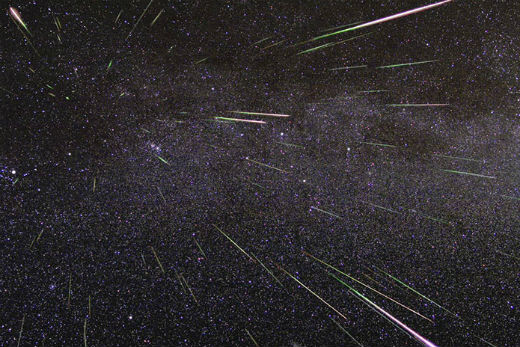
More meteors than you can shake a stick at. Photo: NASA.
The Perseids are expected to be peaking this week over August 11, 12 and 13 with about 150 meteors an hour, but they are mainly a northern hemisphere show. The Delta Aquarids are assumed to be past their peak but will continue to produce shooting stars into early August.
Auckland Sky Dome astronomy educator David Britten says the Perseids are visible from New Zealand, if you have a good view to a low northern horizon.
'You might see some if people can find Matariki the Pleiades, meteors will appear to be coming from a point directly below that point in the sky, almost directly due north,” says David.
The best time to look for Perseids is after 3am.
'After about 7am in the morning it starts getting more difficult, because the sky is brightening and meteors aren't very bright,” says David.
'When we say a meteor shower, it's not boom, boom, boom, like we seen in the movies. There's maybe 20 an hour, and again a good proportion are going to be faint. If people want to see them they really need to get away from any city lights.”
Meteor showers all appear to come from one point in the sky. It's a perspective effect a bit like looking at parallel railway lines that meet in the distance. That point in the sky for the Perseids is below the horizon in the north.
'So it's about 15 degrees below the horizon. It's only the brighter ones we are going to see, and only the ones on the top side of that cone. More than half of them we can never see because they are below the horizon completely.
'If they are predicting a really good shower it might be worth getting out and having a look if people are in a really good location.”
Predicting meteor shower numbers is an inexact science, says David. Worse than weather forecasting.
There is another meteor shower visible from New Zealand called the Southern Delta Aquarids which is also visible in early August. It's not as numerous but it is in the south in the constellation Aquarius, that's more towards the west.
'But the radiant point is actually above the horizon,” says David. 'Get out look from west across to north and with a bit of luck you might see meteors coming from two directions.”
The Delta Aquarid meteors may appear a bit fainter than the Perseids and meteors seen in other major showers, making a dark moonless night important.
About five to ten percent of the Delta Aquarid meteors leave persistent meteor trains – glowing ionized gas trails that last a second or two after the meteor has passed. The meteors burn up in the upper atmosphere about 100 km above the Earth's surface.
The Perseid meteors come from the debris trail left by the coment Swift–Tuttle on its 133 year-long orbit. The Perseids are so called because the radiant, their origin point in the sky, is in the constellation Perseus.
You see more in the pre-dawn hours as more are scooped up by the side of the planet moving into the stream.
The way to see a meteor shower is to sit outside for a few hours in a dark area with as big a sky as possible. It takes about 30 minutes for human eyes to adjust to the dark, and the longer you wait outside, the more you'll see.

0 comments
Leave a Comment
You must be logged in to make a comment.