


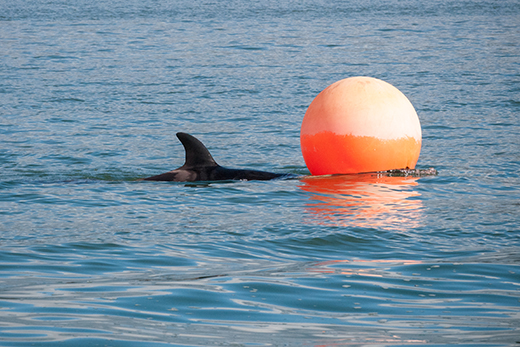
DNA samples from a male orca calf have been rushed to a lab this afternoon for testing in an attempt to establish which orca 'family” pod he belongs to.
The hope is that the lone male, who has been in the Bay of Plenty area for more than a week, can be reunited with his family.
Members of the community are being asked to stay away from an orca calf that's been spotted in the Bay of Plenty recently. Photo: Project Jonah/Facebook
Working towards this end Dr Ingrid Visser, founder of the Orca Research Trust, and Jeff Foster, an international orca expert on rehabilitation, today took a DNA sample from the orca.
'This was like collecting dandruff from a human. The skin flake will be used for DNA sampling to see if the calf belongs to the orca population living around New Zealand,” says Ingrid.
Ingrid and Jeff Foster also took a sample from the orca's breath by holding a plastic disk with an agar solution, above the animal's blow hole. The agar captures particles in the orca's breath.
The breath sample will be sent to a laboratory to test for bacteria, pathogens and fungi that maybe having a harmful effect on the orca.
It will take several days to get the results of the breath sample and DNA sampling.
The tactical team set up to respond to the plight of the orca are yet to receive reports of nearby orca pods to which the young calf might belong.
Recreational and commercial boat operators are being asked via the coastguard's marine radio to report sightings of orca pods in the Bay of Plenty region to the Orca Research Trust by phoning: O800 SEE ORCA / 0800 733 6722
The decision to enlist the coastguard's support was made by the Orca Tactical Planning Group made up of members from a broad range of disciplines, backgrounds and cultures.
They have diverse skills, and are working together to achieve the best possible result for the whale.
'We're really grateful to Tauranga Coastguard for helping the OTPG with one of our goals - seeing if we can find this lone orca calf's family pod,” says DOC Orca Incident Controller John Lucas.
'This group is in agreement that reuniting the lone orca calf with its family pod is the key to its long term survival in the wild.
'The difficulty we all face is finding the young orca's family pod as there have been no indications where the calf has come from,” says John.
The OTPG includes DOC, Iwi representatives Reon Tuanau and Carlton Bidois, Orca Research Trust representatives and key community stakeholders.
'It's vital our people are involved in this situation. All of us have unique traditions and whakapapa connections to tohora. They are part of our identity. We havetikanga processes involving tohora that we want to ensure are respected and observed throughout the course of this kaupapa.
'We have our own whale experts. They have a lot to offer because while they are well versed in the sciences and those sorts of areas, they are also knowledge holders of ancient matauranga in relation to the tohora.
'We also know our local environmental conditions including knowledge about our inshore orca whanau units and when they typically visit the harbour and where they often hang out to feed, where the best orca food is in Tauranga Harbour and the likes, so our people bring huge value in that space as well. We have access to resources and facilities that will be critical to a successful intervention,” says Carlton Bidois of Ngati Ranginui.
A karakia ceremony led by Ngaiterangi Iwi liaison Reon Tuanau has been held on the shoreline near the orca calf.
'The karakia places a protective cloak over the orca calf and the work the Orca Tactical Planning Group is doing to support this taonga,” says Reon Tuanau.
Local residents are currently providing accommodation, transport and provisions for the Orca Research Trust team and expert personnel bought in to assist with this task.
'Community members have appreciated the opportunity to work proactively with the local iwi, the Orca Research Trust, DOC and United States orca specialists in what has been described as a 'once in a lifetime' event,” says local resident Sue Baker Wilson.
The OTPG was formed to manage the key issues threatening the orca's long term survival in the wild.
It's exploring measures that may enable the orca to survive on its own and looking at ways of locating the young orca's family pod.

4 comments
Sad
Posted on 01-08-2016 20:27 | By overit
Poor little fellow. Hope something good happens for it.
What a pity
Posted on 01-08-2016 23:24 | By astex
Although an effort should maybe be made to help the Orca I cannot help but wonder why the same level of effort is not being put into saving the many mistreated children. If the same effort and money was put into solving the problem of mistreated children that problem could be greatly reduced.
Commendable!.....
Posted on 02-08-2016 07:39 | By Jimmy Ehu
so what happens now?, a Orca missing report is issued on Facebook?, give me strength nature does things for a reason, I absolutely cherish these awesome aquatic creatures, but maybe he has been a disruptive influence on the "pod" and has been excommunicated, and they do not want him back!.
Why?
Posted on 02-08-2016 07:53 | By Captain Sensible
I still don't understand why the local Iwi are involved. Maori can not talk to whales nor have any whale whispering powers. I assume most people know that "Whale Rider" was not a documentary???
Leave a Comment
You must be logged in to make a comment.