


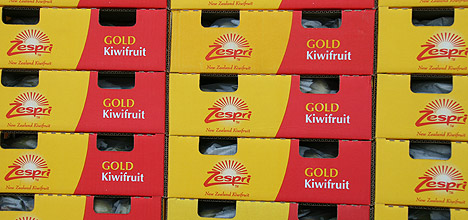
Turners & Growers is seeking more than $2 million in losses plus costs from Zespri over alleged breaches of the Commerce Act in a court case unfolding in the Auckland High Court this week.
T&G also want Zespri's claimed manipulation of the Australian market in the 2009 season declared illegal under the Commerce Act.
T&G wants $330,000 for the Australian issue and $1.8 million over losses in exports for its ENZA Gold cultivar, the rival to Zespri's Gold kiwifruit.
T&G's submissions describe Zespri as a state created private company using monopsony powers to position itself so the single desk seller can retain control of New Zealand's kiwifruit industry when it becomes deregulated.
A monopsony is a single buyer controlled market instead of a single seller controlled market.
Zespri has the sole right to export New Zealand kiwifruit to any market other than Australia – the only market in which T&G can at present compete.
In order to maintain its control of the kiwifruit industry in New Zealand, Zespri has been engaging in strategies to prolong the current regulatory monopsony, and in Plan B to retain control of a future deregulated industry through rolling exclusivity contracts with growers and suppliers and by control of new cultivars, says T&G.
The submissions present a picture of an industry on the brink of sweeping changes, brought about by overseas growers steadily undercutting New Zealand orchardists, and overseas political pressure.
In the last decade, worldwide production of kiwifruit increased by nearly 75 per cent.
Chile is a major competitor of New Zealand for Hayward kiwifruit and its production is expected to double in the next five years, placing huge pressure on the viability of many New Zealand green kiwifruit growers.
New Zealand's distance from markets and higher wage costs make it difficult to compete on a pure commodity basis. Orchard gate returns for Hayward growers have been decreasing in real terms
MAF reports that after deducting drawings for living costs and capital purchases, its ‘typical' model orchard comprising four hectares of Hayward and one hectare of gold, lost $250/ha in the 2009 season.
By contrast, Zespri's projected average net return for Gold growers is $51,233/ha, compared with $9153/ha for Hayward growers.
It is generally accepted by both T&G and Zespri that the future of the New Zealand kiwifruit industry lies in new cultivars, and it is the battle over control of those cultivars that is one of the factors driving the court action.
New cultivars need to be released in the medium term before many New Zealand Hayward growers are forced out of the industry with flow on effects on the 25,000 people currently employed in the industry.
New cultivars therefore have huge market potential and are key to the sustainable future of the New Zealand kiwifruit industry. The New Zealand kiwifruit industry therefore needs to identify and protect premier new cultivars to replace ‘Hayward' and use these to provide a new foundation for the New Zealand kiwifruit industry.
Control of cultivars under the 1999 regulations gives Zespri control of much of the value in New Zealand kiwifruit.
Zespri is in the process of commercialising three new varieties: an early season, gold-fleshed kiwifruit currently known as ‘Gold3'; a long-storing, gold-fleshed kiwifruit currently known as ‘Gold9'; and an early season, green-fleshed kiwifruit currently known as ‘Green14'.
Zespri has also announced that it has two red-fleshed varieties in orchard trials.
T&G is commercialising three new varieties: a gold-fleshed kiwifruit marketed as ‘EnzaGold; a red-fleshed kiwifruit marketed as EnzaRed; and an early season, green-fleshed kiwifruit marketed as Summerkiwi.
Under the regulations, Zespri controls the export of new cultivars. T&G says Zespri will only commercialise a cultivar or fruit from a new cultivar, which Zespri is able to protect through some form of ownership or marketing rights in key countries.
It means the developer of a new cultivar must grant Zespri either a worldwide exclusive licence for evaluation of the cultivar and an absolute assignment of the intellectual property rights associated with the cultivar to Zespri for which Zespri will pay a royalty not exceeding 1.5 per cent of the gross sales price.
T&G says Zespri will not support a cultivar for export unless it has been tested through the Zespri system.
If Zespri was operating in a competitive market, it would not be able to adopt its policies. Instead T&G submits, it would export the fruit of a cultivar provided it was compensated for its opportunity costs of doing so. It would not be able to require, as a matter of course, the absolute assignment of intellectual property rights to the cultivar as a condition of export.
In a competitive market, Zespri would no longer remain an integrated marketer of a limited portfolio of branded products, but would also or instead become a trader.
Zespri's current policy is based on its overall strategy of minimising the number of cultivars from which kiwifruit is grown in New Zealand, says T&G.
It says Zespri's stated aim is to have no more than three kiwifruit products on supermarket shelves at any one time.
T&G submits Zespri is consciously using its current position as a regulated single point exporter to position itself as the only New Zealand exporter with commercialised cultivars planted in New Zealand, in express anticipation of deregulation.
T&G says the effect of Zespri's policy is to constrain T&G's ability to license growers to plant its new varieties in New Zealand. It will also restrict, prevent or deter T&G and other exporters in competing with Zespri after deregulation, since they will not have established premium varieties to compete with those held by Zespri.
T&G says actual or potential pressures on Zespri's monopsony, which could lead to deregulation, include Zespri losing grower or supplier support through poor commercial performance or oppressive conduct as the proportion of non-grower shareholders rises, or as the interests of shareholders and suppliers diverge.
The government could decide to deregulate for reasons of principle or pragmatism.
The government may be forced to deregulate in order to reach or comply with international trade agreements.
New Zealand is currently pursuing free trade agreements with a range of countries, notably through the Trans-Pacific Strategic Economic Partnership Agreement.
The original TPP, between Brunei Darussalam, Chile, New Zealand and Singapore was signed in 2005. Negotiations for an expanded agreement including the United States, Australia, Peru, Vietnam and Malaysia are underway.
Zespri is a ‘State Trading Enterprise' for the purposes of World Trade Organisation rules.

0 comments
Leave a Comment
You must be logged in to make a comment.