


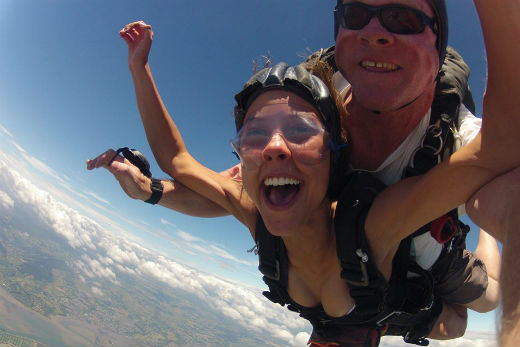
Tauranga's skydiving industry is included among about half the industry's small to medium sized operators being driven out of business by unsustainable Civil Aviation Authority charges.
The CAA 2016 funding proposals is about to take $1.7 million from some of aviation's most vulnerable businesses, with 40 per cent set to be taken from small to medium sized tourist operators like Tauranga Tandem Skydiving, says New Zealand Parachute Industry Chairman Stuart Bean.
Popular tourist entertainment is under threat. Photo: Supplied
'One of the most debilitating aspects of the proposals is the targeted attack on small to medium sized aviation businesses while the larger and most profitable airports and airlines will no longer contribute to funding key CAA services such as surveillance,” says Stuart.
'This quite simply is inequitable and unfair.”
The increases come after former Minister of Transport Gerry Brownlee promised Cabinet in 2012, that CAA costs would be reduced and the need for further increases in fees and charges would be reduced or removed.
'Instead, we find commercial general aviation businesses such as skydiving facing cost increases far in excess of the rate of inflation,” says Stuart.
The CAA funding proposals result in about another $250,000 per year going from the parachute industry to CAA, without CAA having to provide any additional services, says Stuart.
Other small- to-medium-sized aviation companies like rescue helicopters, tourist helicopters/fixed wing and agricultural operations are being similarly targeted, while the largest and most profitable aviation businesses—big airlines, airports and the Airways Corporation—all pay a lot less.
If the cost of parachuting goes up, it will adversely affect tourism revenue nationwide, says Stuart.
The cost of certification has driven prices to a point where New Zealand skydiving businesses are barely competing with Australia, when they used to be significantly cheaper.
'They are now about equal and there's no evidence certification has improved safety,” says Stuart.
'The costs of meeting these new levies will drive prices up even more and further erode competitiveness, possibly leading to losses of revenue for the businesses, the districts they're in, and New Zealand tourism.
'Many visitors to New Zealand are on multi-destination holidays, and may choose to do a parachute jump elsewhere if it is too expensive here,” says Stuart.
'Tourists who are not making a parachute jump in your town may spend less time in your town, or bypass your town entirely on their way somewhere else.
'The implications for the local economy and tourism revenue nationwide are huge.”
CAA certification has already priced parachuting well above other adventure activities that are not as heavily regulated, says Stuart, and higher costs will widen the price gap between parachuting and other adventure activities to a point where skydiving will struggle to compete for the tourist dollar.
'Our ability to effectively compete with Australia is already very tenuous and the new levy will further undermine this with no comparable safety benefits or efficiency gains.
'The new taxes do not represent value for money and should be halted immediately. It is very clear that CAA is presently well funded to discharge all of its functions; these new changes are simply an attack on small to medium sized businesses which help form the backbone of New Zealand's tourism industry.”
Tauranga Tandem Skydiving director John Martin says the number of tandem skydive operators in New Zealand has been virtually halved since the CAA got involved with certifying the sky diving operators.
There were 23 and now there are 11.
'We've been in operation for 24 years and nothing has changed except increased costs,” says John.
'We are seriously concerned whether we will continue to operate in future or become another casualty.
'We are in full support of the NZPI on this and we are quite concerned as to viability of our future operations if CAA continue along this line.”
The CAA Board will make its final decision on April 21, and then sends its recommendations to the Minister of Transport.
CAA makes its money charging the third highest hourly rate in the country for safety audits, but the main source of income is the passenger levy imposed on airline passengers, says Stuart Bean.
Airlines themselves pay the normal hourly rate charges for certification and audit, just like any other sector of the aviation community.
'Airlines appear to have lobbied for a rebalancing on the basis that they are having to pay more than is equitable,” says Sean.
'The Ministry of Transport, in a recent discussion of fuel levies, also made the distinction that it is the passenger and not the airlines paying the levy – CAA appear to be the only agency confused on that point.”
The CAA Board is dominated by individuals who have close present and past professional linkages with those who will benefit most from the proposed changes, says Stuart.
There's no one on the board representing commercial general aviation.
'Many in industry believe there is a conflict of interest with the Board looking after their ‘mates',” says Stuart.
If the proposed changes proceed, only commercial general aviation companies will pay audit costs, which will be buried in an 'operators safety levy”.
Airlines, engineering companies, airports, regulated freight cargo agents and Airways Corporation will no longer make a contribution to audit costs.
CAA can operate for the next three years satisfactorily without having to increase charges. In other words, if they do nothing in terms of changing the funding mix, CAA will still receive income of $43m, because the growth in the number of passengers paying the passenger levy is similar to growth in CAA's expenditure.
6 comments
This is terrible
Posted on 15-04-2016 11:48 | By The author of this comment has been removed.
ALWAYS some WALLIES spoiling peoples DREAMS,those trying to do this (CAA)should all be given a free flight in these planes ,and at 2,000feet all pushed out,(without a parachute) NO MORE whinging,problem solved, anyone else, me going to sit on log and have a tipple,10-4 out. NO1 Thanyou,
Take out
Posted on 15-04-2016 11:49 | By Crash test dummies
It is what they do, destroy something good, then turn around and wonder why there are no tourists in Tauranga, when they happily go about killing off everything tourist like activity.
Common Sense
Posted on 15-04-2016 12:42 | By WaterMad
This is yet another case of pick on the little guy who is trying to survive and put food on the table. The cost of compliance for CAA matters should be ratioed according to passenger numbers surely. This is a fantastic tourist attraction. Come on CAA rethink how you charge!
Kindness
Posted on 15-04-2016 14:10 | By Hunterway
I think the way forward is to avoid criticising the government as they are immune to any worthwhile suggestions and instead take a kindly approach an invite Gerry down for a free skydive.I didn't do much physics because I wasn't at school long enough but I am betting Gerry would reach terminal velocity in spite of the wind resistance any parachute would present.
Hunterway
Posted on 15-04-2016 19:30 | By The author of this comment has been removed.
LOVE YOUR comment,this is awesome ,just like Sunlive, NO1 in the Bay Thankyou.
Taking away the Magic!
Posted on 16-04-2016 00:28 | By YvetteGB
Appalling! People don't just jump on a plane to NZ. It takes a lot of planning and careful budgeting. It's the magic of the people and excitement of things to do that draw us to you. These businesses are already weather dependent, restricting income. There are many other countries to skydive but, NZ has it's own unique sense of magic, making it extra special. It is starting to look like NZ is on the same path of self-destruction as the UK. These businesses already have high overheads - don't choke them to death - they are the dream makers. They keep your country alive and entice us tourists to visit your beautiful country.
Leave a Comment
You must be logged in to make a comment.