


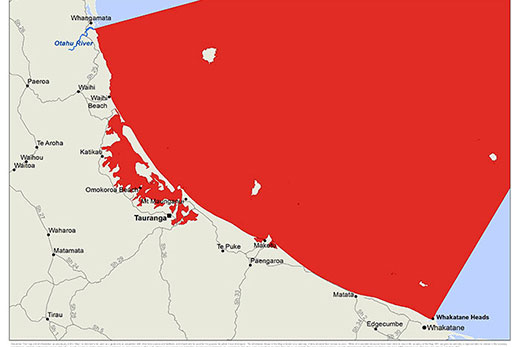
Shellfish in Tauranga Harbour, Maketu and Waihi estuaries, Matakana and Motiti Islands, and all other islands along the Bay of Plenty coastline continue to carry dangerous levels of paralytic shellfish poison.
The Ministry of Primary Industries says shellfish tested in the Bay of Plenty have PSP toxins detected at levels of up to 2.3mg/kg which is over the safe limit of 0.8mg/kg set by MPI. Ongoing testing will continue and any changes will be communicated.
The affected area in the Bay of Plenty.
The affected area is from the mouth of the Otahu River at the southern end of Whangamata Beach, southwards all the way down to the Whakatane Heads.
Affected are mussels, oysters, tuatua, pipi, toheroa, cockles, scallops, catseyes, kina (sea urchin) and all other bivalve shellfish. Cooking shellfish does not remove the toxin.
Paua, crab and crayfish may still be eaten if the gut has been completely removed prior to cooking, as toxins accumulate in the gut. If the gut is not removed, its contents could contaminate the meat during the cooking process.
The Bay of Plenty warning has been in effect since February 19.
PSP warnings are also added today for Hawke's Bay and Port Underwood on the Marlborough Coast.
In Hawke's Bay shellfish are affected along all the coastline between the Mohaka River mouth and Cape Kidnappers. PSP toxins have been detected in shellfish at levels of up to 1mg/kg which is over the safe limit of 0.8mg/kg set by MPI.
In Port Underwood the detected PSP toxins in shellfish are at levels of up to 2.7mg/kg which is over the safe limit of 0.8mg/kg set by MPI.

0 comments
Leave a Comment
You must be logged in to make a comment.