


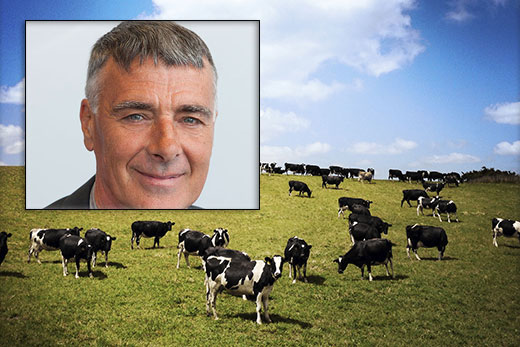
Fonterra isn't Fanshawe Street in Auckland – it's the dairy farmers on every rural highway and side road who work hard and support their local communities, says dairy farmer Doug Leeder.
Doug, who is currently chairman of the Bay of Plenty Regional Council, was closely involved in the restructuring of the dairy industry which led to the formation of Fonterra.
Dairy farmer and former director of Bay Milk, Doug Leeder believes Fonterra needs to get closer to its supplying shareholders, and local and international consumers.
'These are my personal views and do not reflect any views of the regional council,” he told a Bay of Plenty Federated Farmers dairy section meeting.
'In the late 1990s there were two options for the industry; one single company or two. We had a vision for a dairy company which would be the envy of all the inevitable minor processors which would appear in New Zealand, would be really hard to beat and the benchmark for everyone else to aspire to.”
The way in which Fonterra has handled recent events, including its decision to delay paying its creditors for between 60 to 90 days, did not impress.
'As a Fonterra shareholder, I was bloody embarrassed by that and no doubt every member of the Fonterra family, including staff, were also annoyed,” says Doug.
'We are a co-op but more and more behave like that of a corporate. Fonterra is not Fanshawe Street or downtown Tauranga. It's the Fonterra sign people see when they drive on rural roads.
'When Fonterra say it does community social responsibility by giving millions to DOC or using Fonterra ambassadors, you have to question the value that accrues to farmers back on the farm.
'In recent times, as I move around the district, I am hearing that Fonterra is seen as arrogant and a bully boy. Where is the pay back from all that investment in corporate responsibility? The real payback is farmers rearing calves for IHC, and supporting local activities such as coastguard and schools and other community events. These are the aspects from which Fonterra gets buy-in and they are not created in Auckland. They are created here.
'I would suggest that the Fonterra PR/communications department have got these things seriously wrong.”
Doug questions why Fonterra's chief financial officer, Lucas Paravicini, had to front the media over the extension to suppler payments and not front the chair and/or CEO on such policy matters.
'The shift from 30 to 90 day or 60 day payments was a policy decision made by the board. It is not smart governance and sure as hell not smart executive thinking.
'At the end of the day Fonterra says it will save $57 million but farmers know all it is doing is pushing credit another 30 days and it is simply the extra interest factor on working capital needs. All the aggravation it has caused is not worth it.”
Doug was a director of Bay Milk in the late 1980s 'when it was down on its knees”.
The board, under the chairmanship of Doug Bull, told the CEO to pay creditors on the 20th of the month despite the company's grim financial situation.
'The company's relationship was with the banks and we had to convince the bankers that we had a strategy in place to meet our obligations.
'The respect that decision to continue to pay on time accrued in the community was totally invaluable. We had loyal contractors that staff could call out at any time if necessary and they'd be there. The current environment with Fonterra, I suspect, is totally opposite.”
Doug has some concerns about Fonterra's current strategy. 'Australia and China Farms are under-performing. The payout in Australia is $5.80 which is not the milk price but what happens in Australia is that there are multiple processors so Fonterra has got to pay that price so as not to lose supply and have a redundant asset.
'In New Zealand at this stage, relationships with farmers is not good which is why alternative processors have waiting lists.”
He acknowledges the difficulty for Fonterra is that it must take all the milk offered to it and under the Dairy Industry Restructuring Regulations, known as DIRA, has to provide independent start up dairy companies with milk as well.
The significant growth in milk volume has put pressure on the company and it's not possible to re-direct millions of litres into value added products every day, Doug says.
'Other dairy companies like Tatua and the Dairy Goat Co-op are market led. The goat co-op does not take on supply until it has developed the markets for it. Fonterra is not able do that given the volume it's required to take.”
Doug questions where added value development is going and if the work begun by the former dairy board into innovative research through product development centres have enough focus and commitment.
He is not fan of the Global Dairy Trade auction which ultimately sets the milk price.
'I've never been in favour of it. In a bull market no one complains but in a bear market it becomes really difficult.”
He likens it to second hand car auctions, where there is no certainty on prices from day to day.
'I understand the logic and the need for a transparent international milk price but is this the best methodology?
'It's a concern that on reading the Commerce Commission's view on DIRA where they are now suggesting that Fonterra's share of supply would have to drop to 70 per cent to justify taking away the regulations.
'They can say what they like, but farmers such as you and I have currently fronted up with the capital to process 85 per cent of milk. If Fonterra only gets 70 per cent, what does it do with the redundant assets?
'Nowhere is this implication better understood than in the Bay of Plenty where we lost land to kiwifruit and had a whole lot of assets worth scrap value,” says Doug.
'At the end of day, responsibility for performance good or bad results, rests with the Fonterra board and executive. To be successful Fonterra needs to get closer to its customers who are your supplying shareholders and your local and international consumers. It is about enduring partnerships not about short term opportunism.”

4 comments
Brilliant
Posted on 12-04-2016 13:27 | By penguin
I am not a farmer but have been associated with the sector in other ways. Congratulations, Doug Leeder, for your excellent and well aimed comments. Fonterra is going to lose a lot of goodwill and supplier understanding by continuing down its path of arrogance. The bigger they are...!
Conflicit view
Posted on 12-04-2016 16:44 | By Crash test dummies
The merger was also going to distance even further, farmers from their Co-op, to the point where a chunk has been sold off to investors, now the company is beholden to shareholders first, farmers get what is left after all the dividends, bonus and glass castles are built and paid for ...
Farmer exploitation
Posted on 13-04-2016 09:23 | By Towball
Is paramount here again. Basic maths suggests this co-op corporation that manages to service the WAGE bill to EXECTIVES alone then coupled with half yearly profit announcements is close to servicing NZs deficit. Take a look Bill English. All at the EXPENSE yet again of the SHOP FLOOR. Pull the carpet from under these BULLIES and their CHINESE PARASITES who are literally MILKING us DRY !. Saying about people in glass houses .............
Farmers
Posted on 13-04-2016 09:57 | By Kenworthlogger
Well well well, the farmers all voted for this and they are now all having a whine when things go wrong. Its Always good to have a competitor in the market not one domanant company.
Leave a Comment
You must be logged in to make a comment.