


New Zealand's dairy farmers are in for another tough financial year but milk prices are expected to improve over the next five years.
Internationally dairy commodity prices are 'trapped” in a prolonged and very deep cycle but there is a glimmer of hope in the medium term Rabobank's dairy specialist Emma Higgins told those attending the Bay of Plenty Federated Farmers Dairy Section meeting at Awakeri.
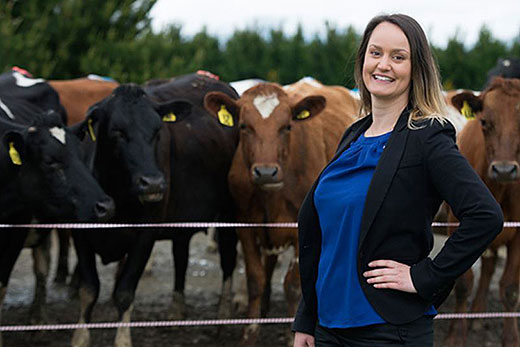
Milk prices will improve – but not in the short term, says Emma Higgins, Rabobank's dairy specialist.
'On a more positive note, the outlook for next five years is that we expected the global economy to very much improve with improved consumption growth, especially in emerging market areas where it is uneconomic or inefficient to produce their own dairy products,”says Emma.
'It's expected that an additional 20 billion litres of milk will be required to meet the gap. 20 billion litres is more or less New Zealand's total production so New Zealand could not meet all that demand.”
While some of the additional production could come from Australia, it will be Northern Hemisphere countries which fill the gap.
'If more milk needs come from the Netherland and the US which have higher cost structures, what needs to happen in the next five years is for prices rise to incentive additional infrastructure investment to cope with additional demand coming out of the improving global economy.
'New Zealand was the lowest cost producer in 2015 so is well placed with its low cost structures to maximise on this demand going forward.
'2016 will be another tough year and I know it's hard to look five years out when you are at the bottom of a cycle, however, we expect things to improve. Current dairy prices are unsustainable across the globe and New Zealand is in a good position to take advantage of improvement.”
However, Emma says milk prices are expected to remain low in 2016 at around $US2000 to $US2500 per tonne of whole milk powder with no up-side in sight until the middle 2017.
A number of factors have impacted on the current low dairy prices internationally, including reduced imports into Russia and China, the lifting of production quota on European Union dairy farmers and the collapse of the oil price.
The Netherlands and Ireland together account for 55 per cent of the total volume of milk produced by Europe and production across the continent is also up because of a mild winter.
Some European dairy co-operatives have been topping up suppliers' milk price by one to two Euro-cents a litre to help farmers keep their heads above water and ensure production remains strong, but Emma says there are signs these companies are now discontinuing the practice.
The Norwegian government is to put restrictions on phosphorus leaching from its farms. In anticipation that these would be based on historic stocking rates, many farmers have increased animal numbers in the hope that would give them an advantage when regulations come into force.
The low value of the Euro has also encouraged more exports of milk products as opposed to supplying domestic markets.
The El Nino drought predicted for New Zealand this summer didn't eventuate and excellent conditions mean grass continued to grow and milk production did not decrease as much as thought, says Emma. A slump in the international oil price has also had an impact on milk prices.

4 comments
Profit
Posted on 04-04-2016 10:49 | By Kenworthlogger
The article says nz farmers were the lowest cost producers in 2015. If they are not making any money out of it how do farmers in other countries make money?
Subsidies
Posted on 04-04-2016 20:41 | By astex
EU farmers earn up to 42% of their income from subsidies. Most of the major suppliers worldwide are subsidised and milk production is increasing. Ireland is aiming to increase production by 50% by 2020. In a way NZ farmers have contributed to their own problems by increasing production by 31.9% from 2008-2015 with the EU increasing by 12.4% in the same period. (source stuff.co.nz) This situation will NOT get any better and someone (Fonterra?) needs to "fess up" to this fact instead of talking up the farmers to maintain their corporate income.
Thieves
Posted on 04-04-2016 21:42 | By Capt_Kaveman
Fontera just a pack of thieves living off the farmers of nz while they in turn pollute are water ways
Just milking it
Posted on 05-04-2016 14:09 | By Towball
Fontera have been allowed the same free run and control as a lot of other big coporate companies who tell the Government what is going to happen resulting in what farmers and N Z are picking up the pieces from. Of course the banks want to help they cannot afford a crash it will cripple the housing market and our economy, meanwhile the big boys come out higher on the hill than ever. Wrongfull that this is allowed in this modern age with so much global intervention to support people in need while our own people go down the drain.
Leave a Comment
You must be logged in to make a comment.