


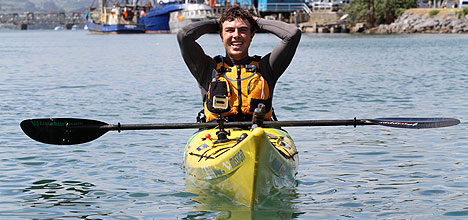
Tim Taylor is today camped out in Cannibal Cove, Queen Charlotte Sound, waiting out a southerly before crossing Cook Strait.
Cannibal Cove is the next bay north from Ship Cove.
Tim Taylor.
Tim's spot tracker shows he visited Ship Cove on Wednesday then headed back to the Department of Conservation campsite in Cannibal Cove.
Camping is not permitted in Ship Cove.
He's there until Cook Strait lets him pass. Known as the wind tunnel of the South Pacific, the strait is the only gap in the chain of mountains extending from Fiordland to East Cape. It is a natural channel through which air streams approaching central New Zealand are diverted and accelerated to pass between the islands.
Wind velocities of about 240km/h have been measured on the Wellington hills facing Cook Strait.
Strong gales 100km/h or more occur about Wellington and in the strait about 30 times per year, on average.
Cook Strait is as notorious for its treacherous currents as it is for high winds.
The tidal currents generated in the strait reach a velocity of about eight knots westwards and four knots eastwards and are erratic depending on wind and weather conditions.
The MetService marine forecast for sea area Cook today is for a 20 knot northwester to change to a 35 knot southerly this morning, easing to 25 knots this evening.
There is a three metre swell, rough seas and fair visibility in morning showers.
The wind is expected to ease Friday afternoon to a 15 knot southerly and become overnight Friday variable 10 knots.
A 15 knot northerly is expected to develop Saturday afternoon, rising Sunday to 30 knots with rough sea.
Tim crossed Cook Strait south bound on New Year's Eve. His mission is to be the first person to kayak around the country in a single voyage.

0 comments
Leave a Comment
You must be logged in to make a comment.