


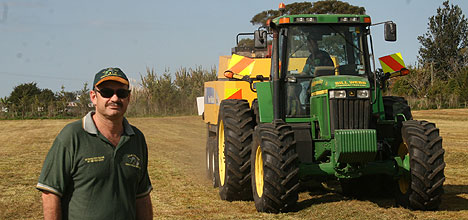
Bay of Plenty contractor Bill Webb is not sure how much longer he can absorb the 44 per cent increase in the cost of diesel.
Diesel has gone up from $1.18 to $1.699 since last year, with some Bay of Plenty service stations selling it at as high as over $1.70.
Soaring diesel prices are costing contractor Bill Webb an extra $1600 a day.
'That's a 51 cent rise since I set my prices at the start of the maize season,” says Bill.
'That makes quite a bit of difference to the cost of running our machinery.
'We are trying to hold our prices, trying to absorb that cost, but we might not be able to soon if it doesn't stop going up.
'It cuts into our margins, and it takes it directly off our bottom line.”
For the 150,000 plus litres of diesel the contracting machines go through in a season – Bill says the higher diesel price is costing him an extra $76,000.
'That's what I've got to cover.
'So that's a wee bit of difference for sure – it's an additional $76,000 we hadn't budgeted on. You can see how easily it would be to get blown out.”
The 51 cent increase in diesel means the harvester is costing an extra $25/hectare – or $30/hour to run says Bill.
'That is about a five per cent increase in the hourly rate just for fuel.”
The two maize harvesters both go through 800 litres of diesel each in a day, while the 13 tractors combined take 1500 litres.
'It is such a big amount, I thought crikey – ten years ago we were buying diesel for 50 cents a litre.”
Bill Webb Contracting travel as far as Khikihi in the Waikato for work, which is something Bill says he is going to have to look at closely.
'I have to look at the cost of getting machinery to jobs. I have to look at the viability. But there are jobs that have to be done.
'It's making a fairly big impact on the industry and the industry has to work together.”
Bay of Plenty Federated Farmers president John Scrimgeour doesn't think we have seen the peak of diesel prices yet.
The dairy farmer says the escalating prices is relieved by the increase in income.
'It is a concern as it (diesel) is a key input for farmers, but on the other hand we have to be realistic and understand.
'There is more money in circulation and more opportunity to buy our goods – which are going at good prices at the moment.
'It's not all bad news is what I'm saying.”

0 comments
Leave a Comment
You must be logged in to make a comment.