


A Bay of Plenty professor is part of a group of academics taking a lead role in improving health and education outcomes in Kiwi children.
University of Canterbury's College of Education, Health and Human Development Professor Angus Hikairo Macfarlane is the Maori research leader for the new government initiative.
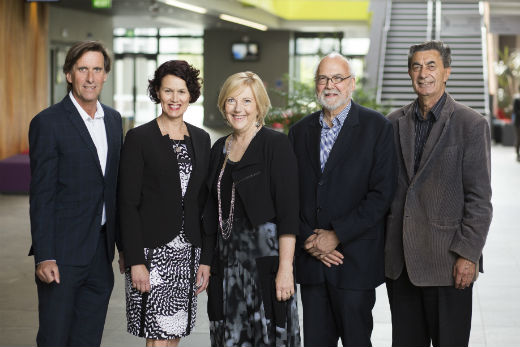
(L to R) A Better Start's Science Leadership Team is Professor Wayne Cutfield of the Liggins Institute (obesity), Professor Gail Gillon of the University of Canterbury (literacy), Professor Sally Merry of the University of Auckland (mental health), Professor Barry Taylor of the University of Otago (big data) and Professor Angus Macfarlane of the University of Canterbury (Maori research). Photo: Supplied.
Angus is one of a number of academics working on the challenge. He is joined by the University's College of Education, Health and Human Development pro-vice-chancellor Professor Gail Gillon who is co-directing the government initiative, a new National Science Challenge – A Better Start: E Tipu e Rea – which was launched by Science and Innovation Minister Steven Joyce on Friday February 19.
Gail is also a principal researcher in the Challenge, which aims to improve the potential of young New Zealanders to have a healthy and successful life by reducing obesity and improving learning skills and mental health in New Zealand children and teenagers.
The challenge for A Better Start: E Tipu e Rea is to identify critical health, education and mental health issues that, if prevented or resolved, would have a major positive impact on the vulnerable children's lives, she says. The Challenge has identified childhood obesity, early literacy and behavioural problems are critical areas, respond to research-based intervention and can lead to vastly improved outcomes for the individuals and society.
Gail, who affiliates to Ngai Tahu, says Maori scientists and communities are integral to the research strategy.
'It's fitting that A Better Start's Māori name, E Tipu e Rea, means 'grow and branch forth. Our research will be designed in line with kaupapa Māori principles, to braid together indigenous and Western scientific understandings and processes.”
Angus says New Zealand has a significant proportion of tamariki and young people with health, educational and mental health vulnerabilities.
'These vulnerable tamariki are concentrated in low socioeconomic communities with a disproportionate burden falling on Maori and Pasifika,” he says.
The Challenge involves collaboration with other New Zealand universities, including Otago, Massey, Auckland and Waikato, as well as Crown Research Institutes and other research organisations as part of a broader, multi-disciplinary team.
A Better Start is one of 11 National Science Challenges designed to find solutions to large, complex issues facing New Zealanders. The University academics are involved in all 11 of the National Science Challenges.

1 comment
Hmmmm
Posted on 21-02-2016 13:38 | By How about this view!
The intentions may be good, but will it just be tinkering for the sake of using up some grant monies?
Leave a Comment
You must be logged in to make a comment.