


UPDATE: 2.15pm: The Ministry of Civil Defence & Emergency Management has cancelled the National Tsunami Warning (Marine and Beach Threat) issued yesterday after the earthquake near Chile.
'We have reviewed the situation and believe the warning no longer needs to be in place as the threat to New Zealand's East Coast and Chatham Islands has largely passed,” says Sarah Stuart-Black, Director, Ministry of Civil Defence & Emergency Management.
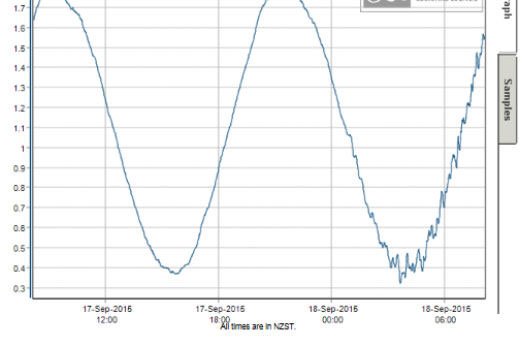
The tsunami track at Whakatane.
Earlier:
Port of Tauranga tide gauges are still displaying the effects of the tsunami shockwave that followed yesterday's Chilean earthquake.
Port of Tauranga operations manager Phil Julian says the effects first become noticeable at around 1am on the outgoing tide, and matched the civil defence forecast of 30cm in height.
During that period, the disturbance was visible between midnight and 3am.
'It's hard to tell how high it was with the data we have got.” Admits Phil, 'but you can definitely see it has gone through.
'There was a nice smooth tide cycle until 1am, then it's gone all over the place.
'It's still out of wack at the moment.”
Normal tide cycles present a smooth sine curve which has been interrupted, and remains ‘wobbly' this morning.
The Whakatane tide gauge readout, as posted on the Western Bay of Plenty civil defence website, shows a similar pattern.
In its notice yesterday, Bay of Plenty Civil Defence urged people in coastal areas of the Bay of Plenty to be aware of tidal surges for the coming 24 hours.
They're asking people to keep away from beaches, coastal areas and river mouths for 24 hours after the tsunami arrived, as it is expected to bring unusually strong currents and unpredictable water flows near the shore.
The Sendai tsunami, following the Japan earthquake in March 2011, was more powerful. The incoming tide stopped, then accelerated to four knots in about 20 minutes, with tidal surges continuing over following days.

0 comments
Leave a Comment
You must be logged in to make a comment.