


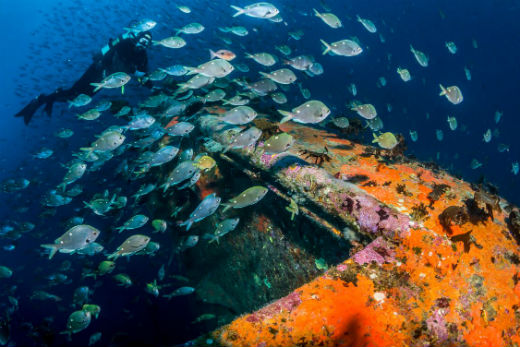
The application for resource consent before the Rena tribunal is not simply a proposal by the owner and its underwriters.
That's the message from one of the Rena's owners, who insists it is an application developed and informed every step of the way with the feedback of the community, local authorities and Maori.
Photo: Darrel Torckler/Andy Belcher.
The representative of owners Daina Shipping Company, Konstantinos Zacharatos, explained the process to the panel yesterday.
A director of the parent company of Daina, Costamare Inc, Konstantinos has spent a considerable amount of time in New Zealand over the last four years meeting and talking to local Maori about the Rena.
'And we are still here,” he says, 'still working and trying to honour our promise to provide a responsible resolution of the incident.”
As a result, works on the site have been extended to the point where, with the exception of stricken Italian cruise ship the Costa Concordia, the Rena salvage operation is by far the most expensive operation in maritime history, with a spend in excess of $500m dollars.
Feedback received and concerns raised during the owners and insurers engagement with local iwi and hapu also saw the scope of salvage work amended several times.
'We went back again and again,” says Konstantinos, 'adding more work in the hope that we could reach a point that would satisfy people, or for those that we could not satisfy, to reach a proper state of affairs that they could live with.
'This is how, four years on from the incident, we are still out there working when most salvage operations around the world stop within one-to-two years.”
It resulted in a much more intensive clean-up of the debris field on the reef than was originally planned, he adds.
They provided a draft of the Resource Consent application ahead of the filing date and made experts available for meetings. The consent period was doubled from five to ten years as a result of Maori input.
'Others had specific comments to the conditions themselves, which resulted in amendments or additions, such as the Mauri monitoring which has been added to the proposed conditions,” says Konstaninos.
'We have been privileged in engaging extensively with Iwi over the past several years. Solid relationships of respect have been built even with persons opposing us today.
.JPG)
Rena principles counsel Matthew Casey QC. Photo: Andrew Campbell.
'I do not see the process here as adversarial. There are Iwi here today, who are real friends and others that I know and respect. I know their families, I know their personal histories, their health problems and how their kids are doing.
'We've spent time together. I think we have taken this journey together, even with those who today do not agree with us. We have always stressed that we wanted to engage, inform and receive feedback and there never was any requirement to support us.
'While we were away, the local project team continued maintaining our contacts with Iwi and kept the engagement going.
'I want to sincerely thank all the Iwi who today support us, but I also want to thank those who do not support us for having engaged with us and informed us over the past few years. I feel that their engagement and even their criticisms have only made the proposal before the tribunal better.”
With regard to the wider community of the Bay of Plenty, they have also had a very important role in shaping the proposal under discussion.
There have been various avenues of communication that have informed and shaped the proposal with the community's views and considerations throughout the past few years, says Konstantinos.
In his opening address the owner and insurers lawyer Matthew Casey QC acknowledged many submitters are opposing the consent because of feelings about the grounding of the fully laden 37,000 tonne container ship on Astrolabe Reef, and the environmental harm that followed.
'This hearing is not about those matters,” says Matthew. 'Consent is not being sought retrospectively to authorise the grounding or the subsequent discharges of contaminants. It is about the future and nothing else.”
The wreck is now in a state where the potential for harm to the environment or to human health is minimal, and any remaining risk will be addressed by conditions of consent, he says.
All that remains now is the partial wreck of the ship and some of its contents. It joins about 3000 other wrecks around the New Zealand coast.
The paperwork filed each day and recordings of the proceedings are available on regional council's website.

2 comments
Rubbish!
Posted on 08-09-2015 16:14 | By DAD
I have heard all the excuses wha about the NewZealanders who have not been able to fish in that area and are not likely to be able to for years to come ! Take the wreck away it will keep destroying the reef in big storms as it moves!
Sorry DAD
Posted on 08-09-2015 20:47 | By astex
but it is you who is talking rubbish. New zealanders have been unable to fish in that area because of the exclusion zone and there is an abundance of sea life there now. See the videos. The reef has recovered with the wreck as an integral part of it now and to remove it would cause much more harm than the original grounding. Leave it there and we could all be fishing there within days.
Leave a Comment
You must be logged in to make a comment.