


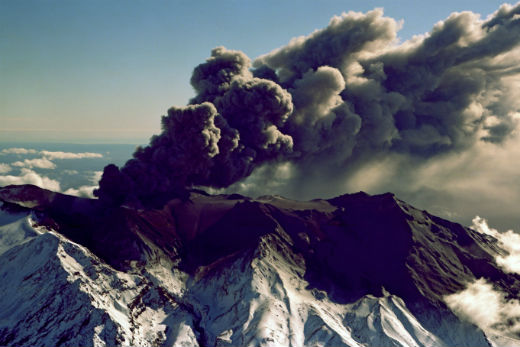
The 20th anniversary of the 1995 Mount Ruapehu volcanic eruptions is being celebrated this week, with scientists reflecting on what they have learned over the last two decades.
Scattered ash from the eruptions landed on the rooftops of Tauranga and Mount Maunganui and the wider Bay of Plenty.
Ruapehu's eruption 20 years ago. Photo: Supplied.
Ruapehu's 1995/96 eruptions ejected a total of 60 million cubic meters of acidic ash – blanketing districts up to 300km from the mountain, irritating eyes and throats in the central North Island, damaging car paintwork and machinery and contaminating rivers and water supplies.
It also ruined crops, closed state highways, forced airports to close and killed livestock which ate ash-covered pastures.
Electricity suppliers were hit with multi-million dollar losses as ash shorted out power pylons and severely damaged turbines in the Rangipo power station. At times, the ash plume reached 10km in altitude, representing a significant aviation hazard.
'We believe this is a great opportunity to reflect on two decades of progress in monitoring, scientific understanding, risk management and social science,” says Director of the Joint Centre for Disaster Research, Dr David Johnston.
Starting in the winter of 1995, a series of spectacular eruptions at Ruapehu became the biggest volcanic event in New Zealand for 50 years, capturing worldwide media attention.
Thankfully, the major eruptive activity occurred while ski areas were closed, so no deaths or serious injuries occurred.
The 1995/96 eruptions were similar in size to the eruptions of 1945, but their social and economic impacts were much greater.
In 1945 there was just one ski area and no ski lifts on Ruapehu. But by 1995, there were three ski areas and 36 ski lifts. By the mid-90s there were up to 10,000 people on the mountain on days during winter.
Volcano Information Specialist at GNS Science, Brad Scott, says in spite of its picture postcard appearance, Tongariro National Park is a highly active volcanic centre and it would be foolhardy to think of it simply as a benign outdoor playground.
Emergency managers, conservation staff, iwi, and university students will gather at Whakapapa Village this week for an event marking the 20-year anniversary of the eruptions.
Starting on August 14, the Volcanic Science and Risk Management Workshop will feature a range of science presentations and activities to reflect on two decades of progress in managing eruption hazards and risks in Tongariro National Park.
It will be held at the Tongariro National Park Visitor Centre, Whakapapa Village. The main workshop is scheduled for Friday August 14, and will be followed by associated activities over the weekend.

0 comments
Leave a Comment
You must be logged in to make a comment.