


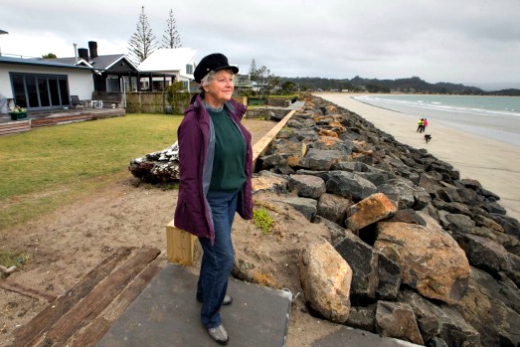
It's not unusual for waves to lap at the windows of Chris Ellett's Coromandel seafront home.
Even after the Cooks Beach woman pulled up her two-storey home and took it seven metres back from the sea, storms still spew onto her back lawn.
Chris Ellett's home at Cooks Beach used to end at the grass area, but she moved it back in response to the sea's advance. Photo: Peter Drury/stuff.co.nz
A rock wall built in front of her house does little to protect her from the elements, but last minute additions are currently being made to strengthen the structure against storms, coastal erosion and rising seas.
Ellett's situation is an example of a previous lack of understanding of the risks of coastal developments, said Dr Scott Stephens, a coastal scientist for Niwa.
'Before we even start talking about climate change, we have problems at the coast which we've created. We built in places where we didn't necessarily understand the science behind coastal processes,” Stephens said.
Historically, coastal settlements such as Pauanui bulldozed dunes to improve sea views and make way for developments, a Waikato Regional Council report on dunes around the region revealed.
Climate change effects on the warming atmosphere will see winds get stronger and waves get larger around coastal areas, Stephens said.
'There is already evidence that extreme wave heights have been becoming larger since they've been measured on satellites, but the big impact we're going to face in the coastal environment is sea level rise.”
'We can't stop sea level rise ... but the rate at which it rises will depend on greenhouse gas emissions.”
Rising sea levels will mean erosion or flooding events that may not be serious now, will become extreme in the future.
'In around 30 years with the sea level rise we're expecting, we would expect sea levels of [extreme] heights reached about every 10 years, then several decades after that, we could expect those levels every year.
'What that means is we'll find that tipping points are reached, at some point [communities] are going say we can't handle this, it's happening five times in 10 years.”
And those who stay, will need to pay. Along with 25 shareholders, Ellett contributed $30,000 to an initial sea wall, built in 2013. She later spent more than $100,000 relocating her house.
Ellett moved her house back in October 2014 and Cyclone Pam hit five months later.
'As soon as [the water] got to the end of the grass, it just shot straight onto the deck.”
Ellett said she's more concerned with serious storms than rising seas, but said since she moved to the spot in 2004 a lagoon outside her house has virtually vanished.
Along the rest of the Coromandel, more walls are sprouting up as part of efforts to try and preserve the precarious shoreline.
Thames Coromandel District Council has just finished construction of a 115 metre rock seawall extension at Whitianga's Buffalo Beach. The rock seawall has been constructed to protect the road, residential properties and the reserve on Buffalo Beach Road from coastal erosion.
'We needed the strength of a rock wall here as the beach conditions can be quite severe,” said Mercury Bay area manager Sam Marshall.
Council poured in $375,000 for the extension, and has set aside $520,000 in its Long Term Plan for further protection at the end of the wall to the dune planting area.
'We'll be investigating the best option for protection, but it is likely to be either a rock wall or an extension of the existing dune planting system,” said Marshall.
At Brophy's Beach in Whitianga, council has begun installing a 530m sandbag backstop wall which will cost $862,000.
Stephens said a strategic response to climate change will need to come from an entire community, 'not just the people living behind a sea wall now”.
'First of all we need to increase our understanding, then we have to start making decisions.”
- Stuff

Niwa costal scientist Dr Scott Stephens. Photo: Peter Drury/stuff.co.nz

0 comments
Leave a Comment
You must be logged in to make a comment.