


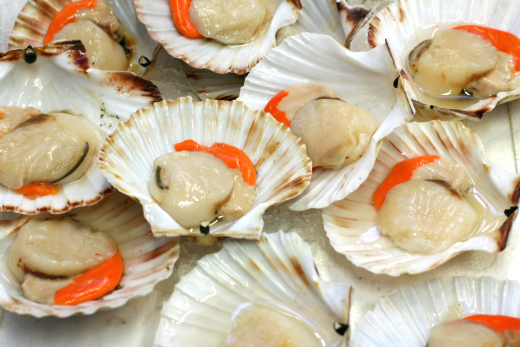
The Ministry for Primary Industries says a combination of many factors is behind the recent poor condition of scallop populations in three locations.
Callers to the MPI's 24-hour Exotic Pest and Disease Hotline earlier this year reported deformed, watery and small scallops around Great Barrier and Mercury Islands, and Pelorus Sound.
The Ministry for Primary Industries say a combination of factors is behind the recent poor condition of scallop populations around Great Barrier and Mercury Islands. Photo: File
MPI Surveillance & Incursion Investigation manager Brendan Gould says they'll continue monitoring the wellbeing of these scallop fisheries.
He encourages fishers and members of the public to report any concerns or abnormalities they observe.
'MPI takes the health of the scallop fisheries very seriously,” says Brendan. 'We also act on information received via the Exotic Pest and Disease Hotline so I'd urge people who gather shellfish to call in if they notice anything unusual.”
MPI's Animal Health Laboratory tested scallops collected from all three areas to determine if the decline in the beds and/or deformation of the roe and muscle was caused by an exotic disease or organism.
AHL staff applied general aquatic bacteriology testing, histopathology and molecular testing to the scallop specimens.
They concluded the mortality and poor condition of the scallop populations are likely the result of a combination of causes.
The specimens from Pelorus Sound showed a high load of an opportunistic bacterium common in New Zealand waters.
Samples from all three sites were affected by a protozoan parasite that infects molluscs and is found in other shellfish species around the North Island and the top of the South Island.
There was also inflammation and some degeneration of the digestive tract in some of the scallops.
This digestive tract damage is found in samples from all three sites and is the most significant finding in the investigation.
The affected scallops do not pose a food safety risk. But, as is the case with any animal, shellfish that are obviously sick and dying should not be eaten.
If you are concerned or notice anything unusual with any shellfish you have gathered call the via the Exotic Pest and Disease Hotline on 0800-80-99-66.

0 comments
Leave a Comment
You must be logged in to make a comment.