


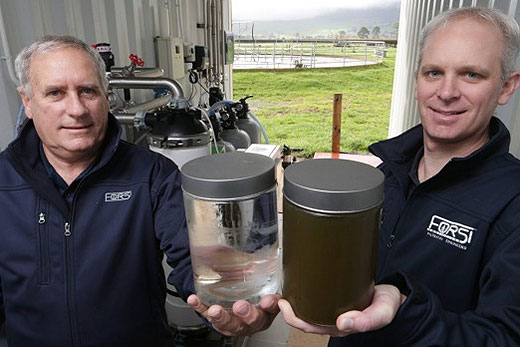
A new effluent recycling system that turns raw dairy shed effluent into clean, clear water could revolutionise the New Zealand dairy industry.
The system is being unveiled at the opening of National Fieldays at Mystery Creek near Hamilton on Wednesday by its creators, Matamata-based water filtration company Forsi Innovations.
Terry Hawes, left, and his son, Craig, Hawes demonstrate the before and after filtration from dairy farm effluent through their Forsi recycling system.
Forsi operations and marketing manger Craig Hawes claims the system will change current farming practices by eliminating the need for effluent ponds, help farmers remain compliant and reduce waterway contamination.
'Over the period of eight years we have been working on the technology and we have finally come to the point where we have got everything where we want it and we have the test results to show that it's of a drinking water standard.”
However, he was not advocating the filtered water be used for human consumption.
'It's come out the back end of a cow and not too many people like the thought of drinking effluent.”
But if one put that image out of their minds, the water would be safe to drink.
'But no one's been game enough to drink it yet.”
Forsi was founded by Craig's father, Terry, who runs the company alongside sons Craig and Darren.
Terry Hawes says the technology could potentially be used in other industries such as factory waste, wineries and human sewage.
'It's a real game changer in the industry. I don't think people realise how big an impact this is going to have.”
He and Darren spent lot of time researching the concept.
'I just knew we could do it. We actually filtered the water a long time ago, but we spent all these years devising a cheaper way of doing it.”
Terry experience as a sharemilker prior to establishing Forsi taught him the difficulties around dealing with effluent compliance.
'We just decided we were going to turn effluent into clean water so there are no more compliance issues. That was our target and we kept working at it until we achieved it.”
The system is housed in a 12-metre shipping container and sits on a concrete pad next to the dairy shed and is plumbed into the pipework that is set into the ground,
It takes the raw cow effluent from the yards through a large sand trap and over a slope screen separator. From there, it enters a suspended solid removal system that removes contaminants.
Terry would not reveal details of this process, citing commercial sensitivity.
The water is then put through further filtration to remove more contaminants and pathogens and four sterilisation steps including UV sterilisation before going into a holding tank. This process took five to six hours and is completed in time for afternoon milking.
While the technology used in the recycling system was not new, this was the first time it had been used in this way to create a new process, Terry says.
The system costs just under $300,000 and included the processing plant and the automated slope screen separation system that separated solids and liquid effluent before it goes into the filtration system.
The product's development had undergone a number of trials and re-inventions over the past eight years before Terry was confident it was right. It had emerged after he noticed farmers' frustration with constant changes around environmental compliance.
The system required a solids bunker for solids to be composted down which could eventually be used as cost-saving fertiliser.
What made this system different from other liquid and solid effluent separators was that it took the effluent right through to a clean water stage. Other systems would only separate the solids and liquid component of the effluent. The green liquid was then placed in the farmer's effluent pond.
It also allowed Waikato farmers facing water restrictions around the regional council's Variation 6 to recycle their water, Terry says.
Craig says he was aware of a similar system in Canada, but that filtration machine was significantly larger than their unit.
He was confident the system could handle significant volumes of water and effluent that result in seasonal rain.
If there was a breakdown, the effluent travels back to the holding tank. An electronic message is sent to Forsi, or the service provider informing them of the breakdown.
'Everything would be back up and running in 24 hours,” he says.
They trialled the system at a 450 cow Matamata farm during the latter stages of last season. While it had not had a full season's use, it had been given every type of variability from rain.
'We have even pumped raw sludge into the end of it and it produced clean water. It doesn't matter what kind of effluent, whether it's dry scraped from feedpads, we can separate all of the solids out and extract the liquid that's in there and filter it out into holding tanks.”
The system can run on a farm of up to 1200 cows. It would also work on farms with larger herds, but would require larger componentry or they would use two containers sitting side by side.

1 comment
Forward Looking
Posted on 13-06-2015 18:34 | By Dollie
Wonderful news! Hope it goes well for you. You deserve it. Recycling effluent is the major environmental issue for the world
Leave a Comment
You must be logged in to make a comment.