


 |
The Wild Side by Brian and Claire Rogers |
Spearfishing is probably the most rewarding form of hunter/gatherer pursuits.
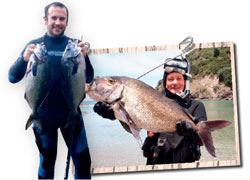 Because the spearfisher is stalking his prey in the fish's environment, it seems a much more balanced contest than many forms of hunting. The statistics bear that out. Spearfishing and diving has its share of fatalities and mishaps. Just recently a spearo failed to surface after nailing a kingfish.
So it's important to remember safety first, because as a landlubber wearing rubber, the human is a fish out of water. Done right, however, it is great fun, exciting and can really bring home the bounty.
The other rewarding aspect of spearfishing comes from the satisfaction of being in complete control of the selection. You know exactly what you are getting, how big it is, how many you take and there's no compulsion to land anything. Some of the best dives are those not measured by the weight of the bag, but the quality of the experience.
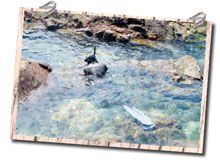 Having said that, my diving is definitely for the purposes of hunting and gathering. The sightseeing trips are fine, but there's only so many pretty things to see before I need to kill and eat something. Cruising over coral reefs looking at the nice nemos is wonderful…for a while. But give me a stretch of wild New Zealand coast any day where I know what I'm looking at and what I can take and eat.
Having just returned from Fiji and some magical snorkelling experiences, I couldn't wait to get back into a 5mm wetsuit and 16 degree water with half the visibility and get a feed.
The opportunity arose in mid November and it was one of those outings not notable for the number of fish speared, but the quality and highly rewarding experience.
The swell had been zero for several days, little rain for a week or so, the wind offshore and the visibility around the coast superb. The water was still a little chilly, so being a wuss, I opted for the thicker winter weight suit.
 Movement might not be quite as free as the 2/3mm summer gear, but toasty warm, knowing that if necessary, I can spend hours in the water without that creeping chill factor. It's also worth remembering the safety value of being warmer than you need – you never know when a quick snorkel might turn into an epic swim, due any number of unforeseen circumstances.
We headed out to a favourite reef off the Bay of Plenty coast and dropped the pick just off the rock that lies a couple of metres below the surface at low tide.
Visibility was about 30 feet, almost too good for spearfishing, since the prey tend to see a spearo approaching too soon. There was, however, an incredible abundance of fish life.
On the reef, we prefer to use a moderate length, single rubber rail gun. It is long enough to have good accuracy and a bit of punch, without being too slow to turn and point. It is ideal for our target species – the likes of greenbone, snapper, dory and occasionally blue moki, kings and porae.
For bigger customers such as kingies, I use a longer gun, with a shark clip attached to the float.
This gun has more stopping power and more range. With the float clipped on, it can be dropped if all hell breaks loose. Getting a clean shot is really important for bigger fish, as you ideally want them stunned with a shot to the spine or just behind the head. Anywhere else means you're in for a long, thrashing ride. Kingies also have a habit, if they're not prone, to encircle the spearo's legs with your own line – and that can be embarrassing at the least and fatal at the worst. But that's a topic for another day.
On our recent dive, it was Butterfish City and easy to pick and choose. Greenbone are one of the most underated fish, possibly because they are not known as a commercial species.
Their heads are small and the fillets come off long and plump. You get a lot of edible fillet for the size of the fish, more so than a lot of other species that seem all head. The flesh is white and firm.
With four in the bag, we decided that was enough for dinner and decided to see what else was about. There were a few kahawai buzzing in and out, plus a few snapper on the fringes, but too careful for us. The excellent visibility meant they spotted us and darted long before we were close to gun range.
 No sign of any johns this trip, but they are always very hard to spot.
There were red moki by the truckload and the big ones are neat to watch. They're on the ‘don't touch' list, not just because they're rubbish eating, but also too easy to shoot. Ditto a lot of the weed munching clan. There's plenty more better eating and keeping fish about, that provide a challenge to hunt, without picking on the dummies.
Heading back to the boat, we swam across another large rock nearly breaking the surface and I decided to dive down after crossing the top to have a poke around for crays.
Off to my right a couple of long, wispy fins twitching amongst the kelp caught my attention – the unmistakeable features of a very nice porae.
Not to be confused with parore, the porae is similar to the shape of a snapper, but the colouring of a terakihi. They are distinguished by the large lips, for munching little sea critters and the long pectoral fins.
They aren't too hard to spear, but not in the same level as the weed munchers. We rate the eating value very highly and love the flakey flesh, similar to bluenose.
I positioned over the top of the porae and dispatched him with a nice clean shot just behind the head. It stopped him literally dead in his tracks. The spear had gone into bone and I couldn't dislodge it while in the water, so the whole fish and spear were bundled onto the float and towed back.
We could have carried on and filled the bin, but with a policy of only taking what we'll eat and not filling the freezer, we decided a cold woodie was the next target and headed home to the smoker.
It was one of those text book perfect days; great weather, superb snorkelling, good company and enough fish.
Spearfishing with a bit of planning doesn't need to be complicated and I wonder if a lot of divers, having gone down the scuba route, find it all too much of a hassle. Spearfishing takes you back to the grassroots of the hunter-gatherer attitude.
It's simple fun, adrenalin pumping at times, plus great for fitness. The diver can go as hard out or as leisurely, as their ability or mood dictates.
It's the purest form of fishing, in that it gives the spearo a unique ability to exactly select the target and specimens – or just watch them swim by for another day.
Baked whole porae
The Porae was rather large, so rather than filleting it I decided to bake it whole. After gutting and removing the head, I scored both sides and seasoned inside and out with salt and pepper. Drizzle the fish with lemon juice, olive oil and a dash of balsamic vinegar.
Placed thinly sliced lemon, tomato and onion inside the cavity, add parsley and a couple of bay leaves, dot with butter. Drizzle olive oil in base of pan and some white wine, I baked it in my large chef's choice dish on the top of a wood-fired oven. It should take about 40 minutes depending on size of fish and oven temperature.
The leftover baked fish is great for kedgerees or fishcakes. - Claire.