


Tauranga's school bus services are to be stopped at the end of 2014, forcing about 5200 students to find other ways of getting to school.
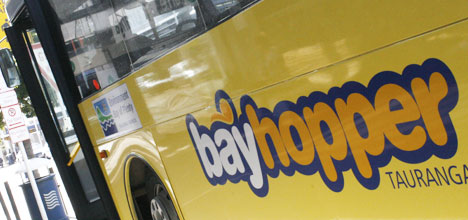
Bay of Plenty Regional Council senior transport planner Emlyn Hatch fears this will overwhelm the Bay Hopper bus service.
Greater pressure is going to be exerted on the Bay Hopper service when the Ministry of Education withdraws its subsidised school bus service in Tauranga.
He also fears it will worsen traffic congestion with more parents driving their children to school.
These concerns were raised in a report received but not discussed at a Tauranga City Council committee meeting on Monday.
The Ministry of Education has funded school buses in Tauranga since the mid 1980s.
The development of the Bay Hopper service since 2001 has placed most of the city suburbs within 500 metres of a bus stop, making almost every Tauranga student ineligible for any continuing government subsidy.
'The development of the public transport network has enabled the ministry to review its position with respect to providing transport assistance to Tauranga students, particularly given Tauranga is the only remaining large urban area in New Zealand where the ministry is doing so,” says Emlyn.
A preliminary analysis finds there is insufficient capacity in the current bus service to accommodate an additional large proportion of the ineligible students.
The ministry transports about 5200 students per day (equating to 10,400 trips) in and around Tauranga using about 85 buses.
By comparison, the 35 Bay Hopper buses, operating over the council's 12 routes, carry about 4200 passengers per day.
It is estimated the Bay Hoppers will carry 1.6 million passengers for the 2010/11 year, compared with 2.08 million in the ministry's school buses.
Withdrawal of school bus services in Tauranga is expected to add about 8000 to
9500 trips onto the road network during the morning peak period.
The total vehicle kilometres on the Tauranga road network is predicted to increase by between 22 per cent and 25 per cent, and total vehicle hours on the network are predicted to increase by between 74 per cent and 91 per cent.
The impact on Tauranga's roading network is predicted to be particularly significant on State Highway 2, State Highway 29 and at Barkes Corner.
The regional council, which operates the Bay Hopper service, has a memorandum of understanding with the ministry, dating from 2008, stating the school buses will be gone by the end of the 2014 school year.
The regional council has commissioned Latitude Planning Services to prepare a scoping report, a draft of which will be placed before the next public transport subcommittee meeting on July 1 to workshop. It is expected to be referred back to council in August this year.
Until the scoping report is completed, staff will be unable to provide good financial estimates to the council as to what it may cost to grow its current contracted Tauranga bus network to cope with the withdrawal of ministry bus services, but the costs are expected to be substantial.

19 comments
Hope this isn't leading to bigger rates subsidy
Posted on 21-06-2011 09:43 | By JSmithington
If the government withdraws tax funding for school buses, don't even think about placing the cost onto ratepayers. It's about time kids either biked or walked to school just like I did when at that age.
Thank you Don Key
Posted on 21-06-2011 11:43 | By Openknee8ted
Central Government saving money by loading the cost onto Local Government and ultimately the rate payer. Just a round about way of introducing new Taxes.
O so community spirited of you.
Posted on 21-06-2011 11:53 | By methinks
Children are just as entitled to have rates spent on them as are the cricketers, hockey players, spa users, bowlers, walkers, race car drivers......, their parents pay rates too and are just as much a part of the community as you! Obviously in your day JSmithington the roads were not as quick, the numbers of cars were far fewer and they were a lot slower. Have you ever tried biking down Cameron Road? Before you make statements like this you should get out there and do it - it's damned scary!! Cameron Road is a dangerous place in a car let alone for an 11 or 12 year old kid on a bike! Can you really imagine adding kids on bikes to our major thorough fares that are already choked with traffic? Have you never seen that very little person standing on the kerb waiting to cross the road and hoping like hell they don't step off in front of you? Our rates would be better spent on keeping kids safe in the community than on day spas, duplicating sports pavilions, gig sites etc. However I'm certain you will not have to worry about YOUR rates going to children as TCC is more in the business of think big, build that white elephant and get your name on it before you kicked to the kerb!
Interesting timing
Posted on 21-06-2011 12:36 | By dgk
Is this before all the Papamoa students switch to the new school, or will some be forced to walk all the way from Papamoa to Mount College?
inaccurate Stats again!
Posted on 21-06-2011 12:57 | By bryceh
This is why issues arise! How the hell can 5200 kids a day on school buses, equate to 10,400 trips a day??! GET SERIOUS. If a bus can hold 60 students, and 5200 students are using the 85 buses every day, how can this equate to more than 10,000 trips? It almost seems like the expansion of the Bay Hopper has been intended to create more people who need to use the service. If they knew about the guidelines for funding the school buses (the 500m from a bustop thing) then this could in fact be the case. Why wouldnt you put a bus stop strategically close to each school, so the government is forced to reduce or eliminate funding for school bus travel??! This would have to mean that MORE people are going to be using Bay Hopper buses. Not all parents have cars, and can drive their kids to school. I would be interested to see what others think on this.
not happy
Posted on 21-06-2011 13:13 | By feebie1
this is really going to cause some stress to parents. Our local intermediate and high school is 7kms away. DGK - we are in Papamoa but not even zoned for new school so our closest schools are the Mount so in effect yes this will mean them finding their own way to school. From the age of 11 I think this is too much to ask. And how are parents supposed to even afford Bay Hoppers if there is an easy route for our kids - I have 4 kids which at some point a round trip for each of them to school and home for the week will add approx $60 to our exoenses a week!
accurate stats
Posted on 21-06-2011 13:16 | By right of reply
i assume 5,200 students travelling once on the bus to school and once on the bus home equates to 2 trips in total. 5,200 students x 2 trips per day = 10,400 studenst trips per day. pretty accurate stats.
Posted on 21-06-2011 13:51 | By sue
So stopping bus services and uping the driving licence age???? Guess more students will be wagging with no way of getting to school when they live too far away to walk. Good on you Tauranga
kapa
Posted on 21-06-2011 15:32 | By kapa
There are no buses from and to Te Puna, even though there are a lot of chidren in this area, no buses run there at all.
Methinks too much
Posted on 21-06-2011 15:37 | By JSmithington
Seem to have upset "methinks" with my wish not to have costs that properly paid by govt through taxes, put onto property owners by rates. I think it's fair enough. Methinks and all others who are upset by government taking away the bus subsidies should be speaking to MPs and the Ministry of Education. They shouldn't lump this extra expense onto ratepayers. Taxes are based on income and a fairer way of subsidy (if there's such a thing) than rates.
Empty buses
Posted on 21-06-2011 16:48 | By gadstuff
From my observations the majority of Hopper buses travel all over the city with hardly any passengers, so why not cut back on the routes that aren't beong used & use the the cost of those buses for the school kids. I agree with JSmithington that kids should be biking or walking to school, which would do them the world of good also. Also parents should be dicouraged from driving their kids to school if they are within reasonable walking distance, or at least car pool instead of one kid & mum per car which seems to be the norm. It is great during the school holidays when all the parenoid mothers are off the roads & the traffic jams are gone.
Unbelievable
Posted on 21-06-2011 20:13 | By Jitter
Another brilliant decision by the Ministry of Education, Wellington based pointy headed beaurocrats. They have no idea of how getting kids to school at the grass roots level operates and why in many cases busses are a necessity. Does this mean that the new Papamoa College zone will be reinvestigated and perhaps extended to include all the Papamoa pupils who currently are outside the zone and are forced to travel by bus to Mount Maunganui College ? There does not appear to be any practical thought put into these decisions. I see that the change will not take effect until 2014 so they (MOE)are giving both parents, college pupils and future pupils plenty of warning. Great ! I fully agree that some Bayhopper bus routes with very light passenger loads could be rerouted to suit school runs. I also agree that more pupils could walk or cycle. However our roads are very busy and dangerous for cyclists and pedestrians. Many pupils will still need to be bussed or taken to and from school by parents due to the distances travelled eg Papamoa pupils currently forced to attend Mount Maunganui College. I am no longer a parent of school age children but can see the reaction many parents will have to this impractical decision which has been made purely as a cost saving excercise and frankly disgust me.
Times Have Changed
Posted on 21-06-2011 20:15 | By Karen
Imagine biking along the Takatimu Dve Expressway into town at 10 years old - our roads have changed, we have huge logging trucks on the road and schools aren't just up the road. We need to provide buses for our children (and future of the city) rather than subsidised Council cafeteria's and junkets that the Council seem to spend all their money on.
Child safety of little concern
Posted on 21-06-2011 22:16 | By Countrygirl
My children live within the 80km zone of Cambridge Road and to walk to the nearest bus stop they would be walking on Cambridge Rd,sharing the road with logging trucks, tankers, 100's of cars and more. There is NO footpath and very little road verge. On a wet winters day the dangers increase as visiblity of the children is minimal. With the removal of their school bus, will our council/govt upgrade ALL our roads and cycle lanes and provide footpaths so that these children can get to school ALIVE??? Somehow I doubt it. It will take the death of one of our children before the error of their ways are clear. How much is a life worth? What value has the govt put on my children's safety? Very little it seems. This isn't a money issue this is an issue of safety and responsibility to our children who are the future of this city.
Well for starters
Posted on 21-06-2011 22:17 | By Nigel Barker
***These concerns were raised in a report received but not discussed at a Tauranga City Council committee meeting on Monday.*** TCC has got this one right. Now where the hell is THE GREAT, THE WONDERFUL the Mr HOW GREAT I AM the vote for ME ME ME. The one - The only ... "Simon"!!!Come forth Simon and speak with us in this open forum & K.I.I.S. Do you have the balls Simon to front up?? Doubt it dude. Just like knowing about how the oldies are abused in the Tauranga District and taking "NO" action. Remember Simon ??? You are very clever and smart as laywers are at hiding behind a screen, talking your way out of things, baffling with bull. Always happy and available to front for the makeup and photo shoot. And of course the freebies - BUT - BUT - BUT, when the going gets tuff ~ Simon says ruff!! This is NOT a TCC issue in my opinion. It is up to the parents with support of Central Govt (Simon take note) to ensure "their" kids get educated.Just as I had to do!! Please! TCC, Mayor Stuart, and Councilors step away from the puter. This is none of your business..... You have my support and blessings to ignore this issue. Stick to your knitting. Stick with providing water, sewer disposal, rubbish collection & adequate roading & systems. ooooo and of course honest open governance. "DO NOT" & just in cased you missed the point "DO NOT" go where angels fear to tread. - Citizens Monitoring Council -
BOLLOCKS Mof E Style
Posted on 22-06-2011 08:48 | By Hebegeebies
It is an issue I suppose so get local MPs involved to do the hard yards and report back with solutions and answers prior to General Election.It is not an TCC or BRC or WBDC issue so keep out of it Councillors.
Dangerous choices
Posted on 22-06-2011 09:46 | By JSmithington
It amazes me how some parents put their childrens lives at risk by buying houses on busy roads with no footpaths. These rural come residential sections might have an appeal of thinking your living the rural lifestyle but they come without the footpaths that are in the urban areas. Dangerous for kids. I think it would be dangerous even waiting for a bus on such roads. The car seems the only choice for these people unless they can persuade the government to pay for the buses.
The issue is FREE, and inadequate main arterial routes
Posted on 22-06-2011 14:32 | By Murray.Guy
If all folk, rather than just the few, were prepared to take responsibility for getting their children to and from school, walk, bike, bus (and pay), their wouldn't be an issue. We always struggle to accept change when it involves having to give up what is a free service to ourselves at the cost of someone else. Safety and congestion is an issue for those students forced to use Cameron Rd, 15th Avenue / Turret Rd (Hairini) and similar inadequate arterial routes.
Wake up
Posted on 22-06-2011 20:54 | By Capt_Kaveman
TGA is the only large city to have govt supported transport, how do u think kids get to school in other places? this is where zoning comes in and if u want yr kid to go to a far away scholl ya gonna have to pay for it on the local service
Leave a Comment
You must be logged in to make a comment.