


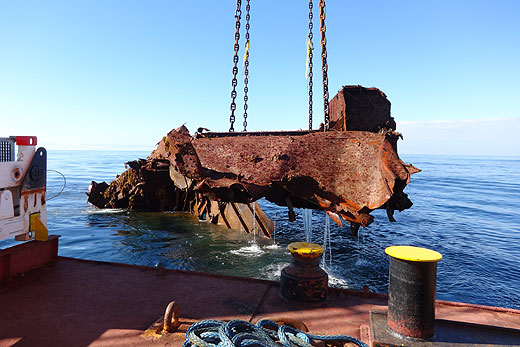
Plans to remove the second part of the sunken aft section of the Rena will not be pursued after a sonar survey confirmed the change in movement during Cyclone Lusi has left it in a risky salvage position.
Spokesperson for the ship's owners and insurers - Daina Shipping and The Swedish Club – Hugo Shanahan says the survey undertaken after the March storm shows the aft section of the hull has moved on the face of Astrolabe Reef.
Removal of the port-side 600-tonne piece of the Rena wreck.
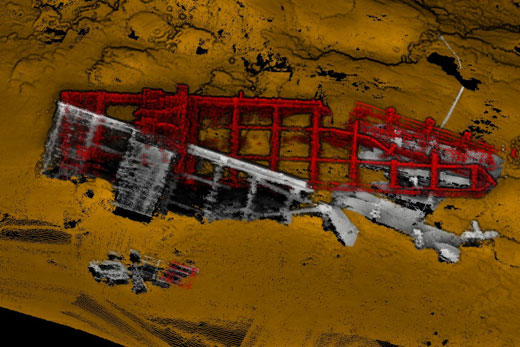
A sonar image comparing the postion of the wreck in April 2013 in red, with April 2014 in grey.
The remaining accommodation block section now lies in water 24m to 53m deep, beyond depths typically accessed by recreational divers.
'The aft section has rotated on the stern, so it is now lying further to starboard and has been significantly weakened, presenting an even greater safety risk and technical challenge for ongoing salvage operations,” says TMC Marine Consultants advisor Roger King.
Due to this movement, Hugo says the removal of that section will no longer be pursued, given it is no longer expected to release flotsam.
It will therefore form part of the resource consent application proposal to leave the Rena section on the reef that was filed with the Bay of Plenty Regional Council on Friday.
Information about the owners and insurers resource consent applications, assessment information and the submissions process will be made publicly available here and from the Bay of Plenty Regional Council when council has completed its review and accepted the application.
The container ship Rena struck Astrolabe Reef at 17 knots early on October 5, 2011. The ship later broke up spilling heavy fuel oil and cargo into the Bay of Plenty. The oil and some of the containers washed up along the beaches.
There's been ongoing debate in the Bay of Plenty over the wreck's ultimate fate. The owners and insurers want to leave the remainder of the wreck on the reef.
Several factions within the Bay of Plenty want the owners and insurers to be compelled by the Environment Court to remove the entire wreck.
The information released today shows this will now be even more difficult and more dangerous for divers involved because of the greater depth of water.
'The movement has helped to expose container and cargo debris that was previously difficult to access within holds four and five,” says Roger.
'As a consequence, Resolve Salvage and Fire is reconfiguring its large RMG 1000 barge to resume operations to further reduce the debris field, which covers the area of seabed between the bow and aft sections, and alongside the wreck to a depth of about 30 metres.”
A second crane will be added to the RMG 1000 for the operation, and a hydraulic grab will be used to recover debris, including parts of the ship structure weighing up to 10 tonnes.
The debris will be sorted into three categories of steel, aluminium and non-metallic refuse before transporting to shore for recycling or disposal.
The operation requires additional mooring lines, and an additional large tug has been sourced to assist with the mooring process.
Once the grab can no longer recover sufficient amounts of debris effectively, divers will re-assess the state of the debris field to identify and target specific areas that require further work. This stage will involve the use of dive teams and possibly a powerful magnet.
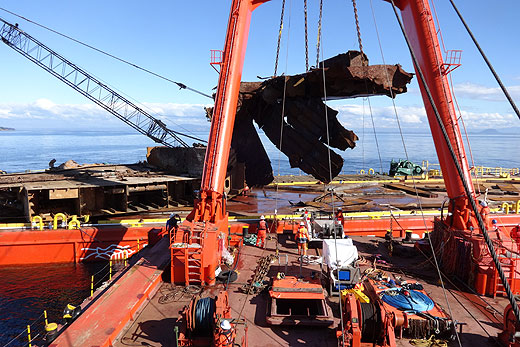
Resolve has recently removed a 600-tonne port side piece, which is currently being recycled back in port.
Divers will now survey the area underneath where the piece lay to try and locate and, if found, recover the last of the plastic bead cargo.
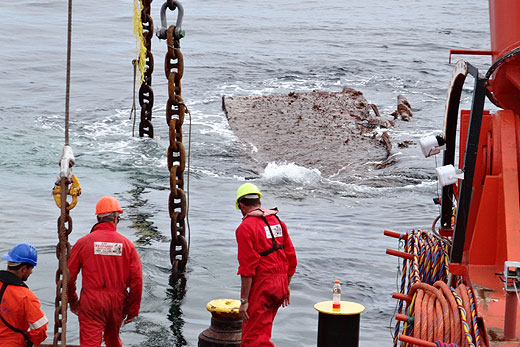 The section is lifted from the water at Astrolabe Reef.
Recent dive surveys of the wreck and debris field have also identified an isolated patch of copper scrap about 1m2 in area, confirmed as the contents from a single container of copper originally loaded in hold six.
This container has not been located during further diver surveys and the majority of the contents are believed to remain largely contained beneath significant structural debris within hold six.
Scientific expert assessments do not expect any on-going significant effect from the copper provided it remains contained. This will be the subject of an ongoing environmental monitoring programme.
'Resolve is going to trial a specialist underwater pump to see whether the equipment can be effectively operated in this location, and at such a depth (about 30m) to remove the cloves,” says Roger.
'If successful, this type of equipment may be an appropriate contingency measure, if future monitoring as part of the resource consent proposal, shows any unexpected results.”
Bay of Plenty Regional Council is currently reviewing the application made by the Rena's owners and insurers.
Communications advisor Linda Thompson says council needs about five working days to review the application, ensure it is complete and ask any questions that are required. Once this is complete council will be able to release further information.

3 comments
Spin out
Posted on 03-06-2014 18:06 | By Sambo Returns
how can we now spin the "Rena thing" out?, I guess like most troughs, they run dry in the end!
Always was
Posted on 04-06-2014 15:28 | By Mary Faith
I think we all know that it was always a 'done deal' to leave the Rena there - regardless of public opinion. They must have thanked their lucky stars to find that the wreck had moved! If this had happened overseas, lifting equipment would have removed it years ago!
Big Mystery with Rena
Posted on 05-06-2014 13:47 | By captainbirdseye
If there is nothing to worry us local residents about with whats left of the RENA on the reef, then why is there still a huge exclusion Zone around the wreck, it does not make sense that now after 3 years, they still wont let boaties and fisherman within 2 miles around this wreck. If there is nothing sinister to hide from the public, then why is this area still closed off? John Key stated 3 years ago that National would ensure that the reef would return to the exact same state as it was before Rena, more Bull,,,,t from politicians and the owners of RENA. Dont let them off the hook or we will pay for it further down the line when crap continues to be washed up on our pristine beaches If there is nothing down there, a simple 500 meter zone would have been OK
Leave a Comment
You must be logged in to make a comment.